Vegan Collagen: Is There Such a Thing? What 'Plant-Based Collagen' Really Means
Natural collagen comes only from animals. What vegan collagen builders and bioengineered collagen really contain, the evidence, and FDA's GRAS letter.
Written by Dimitrun Irene. Updated November 3, 2026.
Natural collagen comes only from animals, so most products sold as "vegan collagen" contain no collagen at all. They are usually "collagen builders": blends of amino acids such as glycine and proline, vitamin C and plant extracts, meant to support the body's own collagen production. The evidence for these blends is thin and mostly comes from small, industry-linked studies. A third category is newer: bioengineered collagen, a collagen-type protein made by microbes or cells instead of animals. As of November 2026, one such ingredient, made by the company Geltor using bacteria, has an FDA "no questions" letter on its GRAS notice (GRN 001171), meaning FDA accepted its safety basis for use in foods. But it is mainly a food ingredient, not a well-studied supplement. This guide explains what each kind of "plant-based collagen" really contains, what the research shows, and how to support collagen on a plant-based diet.
Vegan Collagen: The Short Answer
- 1Collagen found in nature is an animal protein; plants do not make it.
- 2Most "vegan collagen" products are collagen builders: amino acids, vitamin C and herbs, with no collagen inside.
- 3Builder evidence is limited: one 8-week trial of a vegan blend reported skin changes, but it tested a single industry-linked product.
- 4Bioengineered collagen made by microbes exists; FDA issued a "no questions" letter for one such ingredient (GRN 001171).
- 5Plant proteins supply glycine and proline but no hydroxyproline, an amino acid typical of collagen.
- 6Vitamin C and enough total protein are the best-supported basics for anyone avoiding animal products.
Can Collagen Be Vegan?
Not in the usual sense. Collagen is the main structural protein in skin, bone, tendons and cartilage of animals, including humans. Its chain is built on a repeating pattern of three amino acids in which every third position is glycine. Many proline units in the chain are then modified into hydroxyproline (Hyp), a step that needs vitamin C. Plants build their structure from other materials, such as cellulose, and do not produce animal-type collagen. That is why researchers who wanted to make human collagen in plants had to insert human genes and extra processing enzymes into tobacco plants.
All collagen supplements in shops, whether powder, capsules or drinks, are made from cattle, pigs, chickens or fish. Collagen peptides are simply collagen that has been broken into smaller pieces; see what are collagen peptides and collagen vs collagen peptides for the difference. Even capsules sold with vegetarian shells contain animal collagen inside, as noted in collagen powder vs capsules.
What Is Actually in Plant-Based Collagen Products?
Products labelled "vegan collagen" or "plant-based collagen" usually fall into three groups:
- 1Collagen builders: a mix of amino acids (often glycine, proline and lysine), vitamin C, and sometimes plant extracts. They contain no collagen.
- 2Biomimetic blends: amino acids, often made by fermentation, combined in proportions meant to mimic collagen, plus herbal ingredients. A trade publication noted that one such blend "is not collagen in the strictest meaning of the word."
- 3Bioengineered (recombinant) collagen: an actual collagen-type protein made by genetically engineered microbes or cultured cells, with no animals involved.
The table compares these with ordinary animal collagen peptides.
Animal collagen peptides vs collagen builders vs bioengineered collagen
Animal collagen peptides
Bovine, porcine, chicken or fish skin and bone
Yes, as hydrolysed collagen
Multiple human trials for skin and joints, many industry-funded
Not vegan or vegetarian
Collagen builders
Amino acids, vitamin C, plant extracts
No
Vitamin C is needed to make collagen; little direct evidence for the blends
Most common "vegan collagen" product
Biomimetic amino acid blends
Fermentation-derived amino acids plus herbs
No
One 8-week trial (n=90) of one product, 2024
Industry-linked; not independently replicated
Bioengineered collagen (microbial)
Engineered E. coli bacteria
Yes, a collagen polypeptide
FDA GRAS "no questions" letter (GRN 001171) for food use; no published supplement trials in our sources
Mainly a food ingredient
Cell-cultured human collagen
Human skin cells grown in culture
Yes, type I collagen
Developmental; no regulatory status found
Whether it counts as vegan is debatable
Do Collagen Builders Work?
The idea behind collagen builders is reasonable: your body makes its own collagen from amino acids, and vitamin C is a required helper for the enzymes that finish the collagen chain. The NIH Office of Dietary Supplements states that the body needs vitamin C to make collagen. The role of vitamin C is covered in detail in collagen and vitamin C.
The harder question is whether taking these ingredients raises collagen in your skin. A 2017 review in Nutrients found that human evidence for oral vitamin C increasing skin collagen is limited and seems to depend on how much vitamin C a person already gets. Most trials also tested multi-ingredient products, which makes it hard to know which ingredient did what. There is little research on builder blends as a whole, and we did not find good-quality evidence for common add-ins such as bamboo silica.
What Does the Vegan Collagen Study Show?
The most-cited trial, published in the Journal of Functional Foods in January 2024, was double-blind and placebo-controlled. It enrolled 90 people in three groups of 30: placebo, a vegan biomimetic blend, and fish collagen. After 8 weeks, the vegan group showed the following changes compared with placebo:
Skin results for a vegan biomimetic blend vs placebo after 8 weeks (Journal of Functional Foods, 2024)
Collagen density
+4.7%
Elasticity
+5.1%
Wrinkles
-27.5%
Hydration
+4.3%
These results are interesting but limited. The study tested a single product linked to its manufacturer, lasted only 8 weeks, and was small. In the record we reviewed, the methods for assigning participants and the funding were not clearly reported, and it was not possible to judge how the vegan blend compared with the fish collagen group. Results for one blend cannot be applied to other vegan collagen products. For what animal collagen trials have found for skin, see collagen peptides for skin, hair and nails.
What Is Bioengineered or Recombinant Collagen?
Recombinant collagen is made by inserting collagen genes into a host organism, such as bacteria, yeast, insect cells, mammalian cells or plants, which then produce the protein. Because no animal is involved, it is often marketed as "animal-free" or "precision-fermented" collagen. A 2024 review in Frontiers in Bioengineering and Biotechnology explained the trade-off: bacteria and yeast are cheaper to use, but they do not naturally carry out the finishing steps (such as adding hydroxyproline) that make collagen stable, unless they are specially engineered.
Researchers at the Hebrew University of Jerusalem showed in 2013 that tobacco plants given human collagen genes and three processing enzymes could produce human type I collagen that formed stable fibres. That work was aimed at medical and tissue uses, not supplements, but it is the closest thing to true plant-made collagen.
Has the FDA Reviewed Any Animal-Free Collagen?
Yes, for food use. The FDA issued a "no questions" letter on GRAS notice GRN 001171 from Geltor. GRAS means "generally recognized as safe", and a "no questions" letter means FDA did not object to the company's conclusion that the ingredient is safe for its intended uses. The letter is not an approval of any health benefit. According to the FDA document:
- 1The ingredient is a collagen polypeptide made by E. coli K-12 strain S9188 bacteria.
- 2It contains at least 80% protein on a dry basis.
- 3It is intended for use at 2% to 95% in foods such as sports drinks, protein powders, gummies and bars.
- 4It is not intended for infant formula.
- 5The notice was received on November 8, 2023, and the agency's review included amendments through October 15, 2024.
Trade press reported the FDA response in October 2025. Separately, dietary supplements in general do not need FDA approval before sale under US law (DSHEA), so a product labelled "vegan collagen" has not necessarily been reviewed by FDA at all.
Is Lab-Made Collagen the Same as Human Collagen?
Not necessarily. The body contains many types of collagen, and type I is the most common in skin and bone. A 2021 trade report described Geltor's ingredient as matching the "bioactive amino acid core" of type 21 collagen, a rare type that makes up less than 1% of the body's collagen. At that time a clinical trial was in progress, with no results reported, and it was not stated whether the sequence is human. A different approach, from a US start-up, grows human skin cells from a small biopsy to produce full type I collagen at more than 95% purity, aimed first at aesthetic uses. That product had no regulatory status or launch date in the reports we found. Because it starts from human or animal cells, some people would not consider it vegan. For how the main collagen types differ, see multi-collagen peptides and types explained.
Do Plant Proteins Give You Collagen's Building Blocks?
Partly. A 2018 study in Amino Acids measured the amino acid content of plant protein isolates. They all contain glycine and proline, the two most important amino acids in collagen, but none contained hydroxyproline.
Glycine and proline in plant protein isolates (grams per 100 g raw material, Gorissen et al. 2018)
Soy
2.7
3.3
Pea
2.8
3.1
Brown rice
3.4
3.4
Potato
3.2
3.3
Wheat
2.4
8.8
Hemp
2.1
1.8
Whey (comparison)
1.5
4.8
Your body can make glycine, proline and hydroxyproline itself, so not eating hydroxyproline does not mean you cannot make collagen. Collagen is unusually rich in glycine, which is why collagen peptides differ from complete protein powders; see collagen peptides vs protein powder.
Is Vegan Collagen as Good as Animal Collagen?
There is not enough evidence to say. Animal collagen peptides have been tested in many more trials, although many were funded by manufacturers. The only direct comparison we found is the 2024 trial above, which included a fish collagen group, but its results for that group were not available in the record we reviewed. Bioengineered collagen supplements have no published human results in our sources. If you eat fish or other animal products, animal collagen remains the better-studied option; marine vs bovine collagen compares the main sources. If you avoid animal products, a builder is not a like-for-like substitute.
How to Support Collagen on a Plant-Based Diet
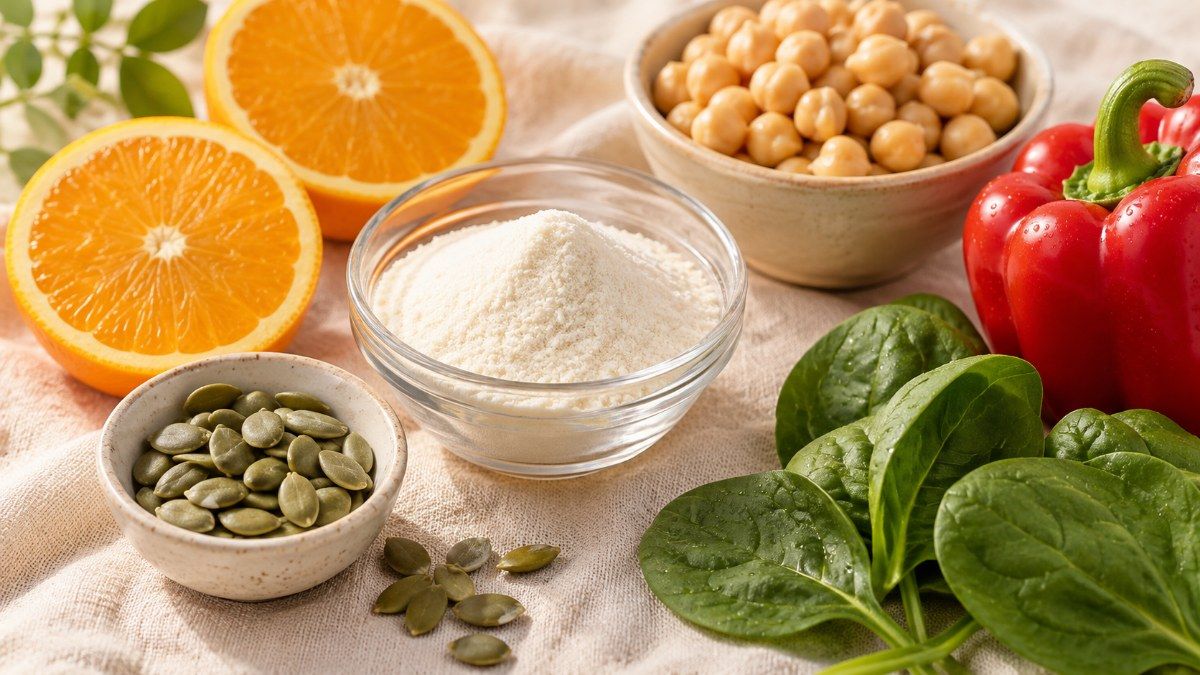
- 1Eat enough total protein from varied sources such as soy, legumes, grains, nuts and seeds.
- 2Get enough vitamin C from fruit and vegetables; the adult upper limit for supplements is 2,000 mg a day.
- 3Treat skin and joint claims on vegan collagen labels with caution, since evidence is limited.
- 4Check whether a product contains collagen at all or only amino acids and vitamins.
- 5Look for third-party testing and a full ingredient list, as described in how to choose collagen peptides.
Questions to Ask Your Doctor or Dietitian
- 1Is my protein intake enough for my age and activity level on a plant-based diet?
- 2Am I getting enough vitamin C, or do I need a supplement?
- 3Could any herbs in this collagen builder interact with my medicines?
- 4Is high-dose vitamin C a concern for me, for example because of kidney stones?
- 5Is there a better-supported way to reach my skin or joint goals?
When to Talk to Your Doctor
- 1If you are pregnant or breastfeeding
- 2If you have had kidney stones, especially before taking high-dose vitamin C
- 3If a product contains herbal extracts and you take prescription medicines
- 4If you follow a restrictive diet and may not be eating enough protein
- 5If you have kidney disease or have been told to limit protein
If you are allergic to fish or have alpha-gal syndrome, some animal collagen may not suit you. Our guide to collagen allergy explains which sources carry which risks.
The Bottom Line
There is no natural vegan collagen: collagen is an animal protein, and most "vegan collagen" products are collagen builders made of amino acids, vitamin C and herbs, with limited evidence behind them. Bioengineered collagen made by microbes is real, and one ingredient has an FDA "no questions" GRAS letter for food use, but it has not been well studied as a supplement. For people on a plant-based diet, enough protein and vitamin C remain the most reliable foundations.
FAQ
Not naturally. Collagen comes from animals. "Vegan collagen" products usually contain amino acids and vitamin C, while bioengineered collagen made by microbes is a newer food ingredient.
A supplement of amino acids such as glycine and proline, plus vitamin C and often plant extracts, intended to support the body's own collagen production. It contains no collagen.
It is made by genetically engineered microbes, such as the E. coli strain named in FDA's GRN 001171 letter, so the production organism is genetically modified.
Collagen builders and plant proteins generally do not; the 2018 study of plant protein isolates found none. Whether a bioengineered product contains it depends on how it is made.
Plant proteins such as soy, pea and rice contain glycine, and the body also makes its own. A varied diet with enough protein supplies it.
No. Marine collagen comes from fish skin or scales, so it is neither vegetarian nor vegan.
Sources
- 1Gorissen SHM et al. Protein content and amino acid composition of commercially available plant-based protein isolates, Amino Acids, 2018
- 2Pullar JM, Carr AC, Vissers MCM. The roles of vitamin C in skin health, Nutrients, 2017
- 3Oral supplementation of vegan collagen biomimetic has beneficial effects on human skin physiology: a double-blind, placebo-controlled study, Journal of Functional Foods, 2024
- 4Cao L et al. Tissue engineering applications of recombinant human collagen: a review of recent progress, Frontiers in Bioengineering and Biotechnology, 2024
- 5Shoseyov O, Posen Y, Grynspan F. Human recombinant type I collagen produced in plants, Tissue Engineering Part A, 2013
- 6US FDA. GRAS Notice GRN 001171: response letter, US Food and Drug Administration
- 7NIH Office of Dietary Supplements. Vitamin C fact sheet for consumers, National Institutes of Health
- 8US FDA. Information for consumers on using dietary supplements, US Food and Drug Administration
- 9Gonzaga University. Collagen structure, Gonzaga University
- 10How is animal-free collagen made and does it work?, FoodNavigator, 2024
- 11FDA greenlights in-demand vegan collagen from Geltor, FoodNavigator, 2025
- 12Geltor targets beauty-from-within market with type 21 vegan collagen made with microbes, FoodNavigator, 2021
- 13Cell-cultured human collagen partnership for aesthetics, Green Queen, 2026
This article summarizes published research for general information and does not recommend any product. The vegan collagen trial cited is linked to the product's manufacturer, and many animal collagen trials are funded by collagen manufacturers.

Dimitrun Irene
Author
Comments (0)
Be the first to comment on this article.
More articles