Collagen Peptides vs. Protein Powder: What’s the Difference?
Compare collagen peptides and protein powder, including their main uses, nutritional differences, and which option may fit your goals.
Written by Dimitrun Irene. Updated October 29, 2026.
Collagen peptides are a protein, but they are not the same as protein powder. Whey, casein, soy and pea powders are built to help you reach a daily protein target and build muscle, and whey supplies all nine essential amino acids. Collagen contains no tryptophan, so it is an incomplete protein, and it is low in leucine, about 2.5 g per 100 g, the amino acid that most strongly switches on muscle building. In a randomized trial in older women, 30 g of whey twice a day raised muscle protein synthesis while the same amount of collagen did not. Collagen still counts toward your total protein intake and is studied mainly for skin, joints and tendons. Choose protein powder for muscle and meal support, collagen peptides for connective-tissue goals, or both if your diet allows.
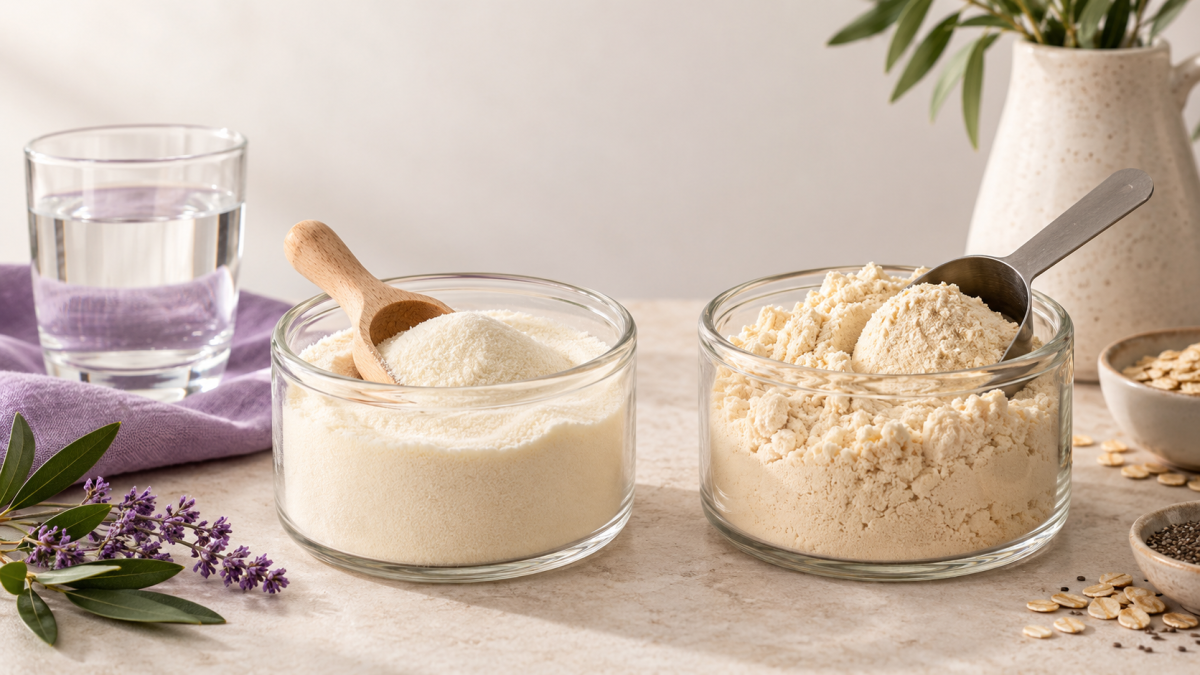
Two tubs can sit side by side in a kitchen cabinet and still have completely different jobs. Protein powder is usually about helping you reach a broader daily protein target. Collagen peptides are more often chosen for connective-tissue goals such as skin, joints, tendons, and nails. Both are proteins, both come as powders, and both are surrounded by confident marketing. That is where the confusion starts. The useful question is not which one is “better.” It is which one fits what you actually want it to do. If you are new to the subject, start with our guide to collagen peptides.
The Short Answer
For muscle gain, recovery, or simply making it easier to eat enough protein, a conventional protein powder is usually the more suitable choice. For a targeted collagen routine, collagen peptides may make more sense when your interest is skin, joints, tendons, or connective tissue. That does not make collagen a replacement for a complete protein source, and it does not make protein powder a beauty product. They overlap, but they are not interchangeable.
- 1Choose a regular protein powder if your main goal is muscle maintenance, muscle growth, recovery, or reaching a daily protein target.
- 2Choose collagen peptides if your main interest is connective-tissue support, such as skin, joints, tendons, or nails.
- 3Consider using both only if both goals matter to you and the extra cost, calories, and routine feel reasonable.
- 4Choose neither if your regular meals already cover your protein needs and you do not have a specific reason to supplement.
Collagen peptides vs whey protein powder at a glance
Complete protein?
No, contains no tryptophan
Yes, all nine essential amino acids
Leucine
Low, about 2.5 g per 100 g
High; whey is one of the richest sources
Main amino acids
Glycine, proline, hydroxyproline
Leucine, isoleucine, valine, lysine
Muscle protein synthesis (older women, 30 g twice daily)
No significant rise
Clear rise at rest and after exercise
Main research focus
Skin, joints, tendons, bone
Muscle mass, strength, recovery
Typical studied amount
2.5 to 15 g a day
20 to 40 g per serving
Counts toward daily protein?
Yes, as part of a mixed diet
Yes
The simplest way to think about it is this: protein powder is usually a general protein tool, while collagen peptides are a more specialized supplement. The right answer comes from your goal, not from whichever tub has the most impressive label.
Why the Comparison Is More Confusing Than It Should Be
“Protein powder” is a category, not one ingredient. It can mean whey, casein, soy, pea, rice, or a blend. These products are generally designed to provide a convenient amount of dietary protein, often with a useful balance of essential amino acids. Collagen peptides are also a protein supplement, but they come from hydrolyzed collagen and have a very different amino-acid profile.
That difference matters because the body does not treat every gram of protein as if it had the same job. Collagen is rich in amino acids such as glycine, proline, and hydroxyproline. It is not usually treated as a complete, muscle-building protein source for general nutrition. A scoop can still contain protein, but the word “protein” on the label does not tell you what that protein is best suited for.
This is also why a collagen powder can be useful without being a substitute for a meal, whey shake, soy protein, or a well-planned plant-protein blend. It is better to ask what the powder contributes to your routine than to compare the two products only by grams per scoop.
What Protein Powder Is Designed to Do
Most people buy protein powder for a very practical reason: it helps them get enough protein without cooking another meal. That can be useful after training, on a busy morning, or when appetite is low. It is not magic, but convenience matters. A supplement that helps you follow a sensible eating pattern is more useful than an impressive product that stays unopened in a cupboard.
If Your Goal Is Muscle Gain or Recovery
Resistance training gives the body a reason to adapt, and dietary protein supplies the amino acids needed to support that adaptation. A complete protein powder can make this easier, especially when a normal meal is not available. Whey is popular because it is rich in essential amino acids and leucine, but dairy-free options can also fit well. Soy is a complete plant protein, while pea, rice, and blended products are often chosen according to preference, digestion, or dietary restrictions.
A serving that provides roughly 20–30 grams of protein is a common practical range, but it is not a magic number for every person. Your total daily intake, training, sleep, and regular meals matter more than forcing down a shake at an exact minute. For a deeper look at how collagen fits around exercise, see our guide to collagen peptides for joints and exercise.
If You Just Need Convenient Nutrition
Not everyone wants to count every gram or build a supplement routine around training. Sometimes the best choice is simply the powder you can digest, enjoy, and use consistently. If a protein shake replaces a skipped breakfast or helps you build a more filling snack, that practical benefit may matter more than small differences between brands.
What Collagen Peptides Are Better Suited For
Collagen is one of the structural proteins found in the body. Collagen peptides are smaller, hydrolyzed fragments designed to dissolve easily and be digested. People commonly choose them as part of a routine focused on skin, hair, nails, joints, tendons, or general connective-tissue support. Those are reasonable goals to explore, but they should be kept separate from the claim that collagen is the best powder for building muscle.
The evidence is not a promise that every person will notice a dramatic change. Results can depend on the product, dose, study population, baseline diet, and the outcome being measured. If your interest is appearance, read our practical guide to collagen peptides for skin, hair, and nails. If your interest is movement or training, our article on collagen peptides for joints and exercise is the more relevant place to start.
The Honest Limitation
Collagen peptides can be a useful addition, but they should not quietly replace the protein you need from meals or a complete protein supplement. If you are eating very little protein overall, adding collagen does not solve the larger problem. It may add one useful piece to the routine, but it does not turn an unbalanced diet into a balanced one.
It is also worth keeping expectations realistic. A supplement cannot correct an untreated injury, replace rehabilitation, fix poor sleep, or compensate for training that is too hard and recovery that is too short. If you have persistent pain or a diagnosed condition, get individual advice rather than trying to solve it with a powder.
The Difference That Matters Most: Your Goal
For Building Muscle
Choose a conventional protein powder first if you are trying to support muscle growth, preserve muscle while dieting, or make recovery nutrition easier. It is designed to contribute to your general protein intake, which is the role collagen is not especially good at filling on its own.
For Joints, Tendons, Skin, or Nails
Collagen peptides may be the more logical experiment if your priority is connective tissue or appearance. Think of them as a targeted addition, not a replacement for food. Give the routine enough time to judge it fairly, track how you feel, and stop if it causes problems or simply is not worth the expense.
For Everyday Nutrition
If your goal is simply to eat well, start with normal meals. Eggs, dairy, fish, meat, soy, beans, lentils, and other protein-rich foods can all play a role. A powder is most useful when it solves a real problem: limited time, a low appetite, a busy schedule, or a dietary preference.
What the Research Says About Muscle
The clearest reason not to treat collagen and whey as interchangeable comes from research on muscle protein synthesis. In a randomized study of healthy older women, whey protein produced greater acute and longer-term muscle protein synthesis than collagen peptides, both with and without resistance exercise. That does not mean collagen is useless. It means whey was better suited to the specific job of stimulating muscle protein synthesis in that study.
The wider protein picture points in the same direction. A systematic review of 49 resistance-training studies found that protein supplementation modestly improved gains in strength and fat-free mass, while intakes above roughly 1.6 grams of protein per kilogram of body weight per day did not add further fat-free-mass gains in that analysis. The lesson is not to chase a bigger scoop. It is to cover your overall needs and train consistently.
Research on collagen and connective tissue is more specific and less tidy. Some studies suggest potential benefits in selected situations, while others do not show the hoped-for change. That is normal in nutrition research. A promising mechanism or one positive trial is a reason to stay curious, not a reason to promise the same result to everyone.
Can You Take Both?
Yes. There is no rule saying you must choose one forever. Someone might use a conventional protein powder to make daily protein easier and collagen peptides because connective-tissue support is a separate personal goal. Someone else may decide that the added cost is not worthwhile. Both decisions can be sensible.
A 2025 controlled study tested a drink containing 25 grams of whey plus 5 grams of collagen in young recreationally active men. The blend increased muscle protein synthesis and, in some conditions, muscle connective-protein synthesis. That is interesting, but it was a small, short-term study of one formula and does not prove that every whey-and-collagen combination improves long-term results. Use it as context, not as a sales pitch.
- 1Use a complete protein powder as the main supplement when general protein, muscle, or recovery is the priority.
- 2Add collagen only when you have a clear connective-tissue or appearance goal and the routine feels worthwhile.
- 3Count the protein, calories, sweeteners, and allergens from both products instead of assuming “more” is automatically better.
- 4Do not let two powders crowd out regular meals, sleep, hydration, and sensible training.
A Simple Decision Guide
- 1Choose protein powder if you want to build or preserve muscle, support exercise recovery, or reach a daily protein target more easily.
- 2Choose collagen peptides if your main interest is skin, joints, tendons, nails, or another connective-tissue goal.
- 3Consider both if you have both goals, understand what each product is doing, and can afford the routine without relying on it emotionally.
- 4Choose food first if your meals already cover your needs and no supplement is solving a real problem.
This approach is deliberately less exciting than a “winner takes all” answer, but it is more useful. Supplements work best when they have a clear job. If you cannot explain why you are taking a product in one sentence, you may not need it yet.
How to Choose a Protein Powder Without Overthinking It
- 1Check the grams of actual protein per serving, not just the weight of the scoop.
- 2Choose a protein source that fits your diet, allergies, digestion, and taste preferences.
- 3Look at the ingredient list for unnecessary stimulants, large proprietary blends, or sweeteners you know you dislike.
- 4Compare cost per serving, because the cheapest tub is not always the cheapest product you can use consistently.
- 5If you compete in tested sport, consider third-party certification and a product with transparent batch information.
A label with more ingredients is not automatically more advanced. In many cases, a straightforward powder that gives you a useful amount of protein and tastes good enough to use is the better buy. You can compare products in our reviews section.
How to Choose Collagen Peptides
- 1Look for clear wording that the product contains hydrolyzed collagen peptides or collagen hydrolysate.
- 2Check the source, especially if you avoid fish, beef, or pork for allergy, religious, ethical, or personal reasons.
- 3Look at the actual serving size and collagen amount rather than judging the product by the size of the scoop.
- 4Be cautious with “beauty blends” that hide many ingredients behind a proprietary name.
- 5Choose a flavor and format you can use consistently, then give yourself a realistic period of time to decide whether it is worthwhile.
There is no prize for making the routine complicated. If you decide collagen fits your goals, our guide to how to take collagen peptides can help you build a simple plan without turning every drink into a science project.
Does Timing Matter?
Timing matters less than many labels suggest. For muscle and general protein intake, your total daily protein and the quality of your overall diet usually matter more than whether a shake is taken within a narrow post-workout window. A shake after training can be convenient, but it is not an emergency if you had a protein-containing meal beforehand.
Collagen products are often marketed with a precise timing promise, particularly around exercise. The research does not give everyone a single magic schedule. Consistency, a sensible serving, and a clear goal are more useful than setting an alarm for a supplement you may not even enjoy. If you are wondering when changes might be noticeable, read our guide to how long collagen peptides take to work.
Common Mistakes to Avoid
- 1Using collagen as your only protein supplement when muscle or general protein intake is the real goal.
- 2Buying a protein powder for joint or skin support and then feeling disappointed when it does not behave like a collagen product.
- 3Assuming the largest scoop, longest ingredient list, or highest price must mean the best result.
- 4Stacking several powders and capsules without checking overlapping ingredients, calories, or allergens.
- 5Expecting a supplement to compensate for poor sleep, an aggressive diet, or training that never allows recovery.
- 6Ignoring persistent pain, digestive problems, or an allergic reaction because the product is marketed as “natural.”
More is not automatically better. If you are tempted to add several servings or combine multiple products, read our guide on whether you can take too many collagen peptides and check with a qualified clinician when you have a medical condition or take regular medication.
If you add collagen to your morning cup, whether the heat damages it is covered in collagen in coffee.
FAQ
Is Collagen the Same as Protein Powder?
Collagen peptides are a type of protein supplement, but “protein powder” usually refers to a broader group of products designed to help meet general protein needs. Collagen can count toward your total protein intake, yet it is not the same nutritional tool as whey, soy, or another complete protein source.
Can Collagen Replace Whey Protein?
It can replace whey only if your goal is no longer the goal whey was serving. If you want a convenient, complete protein source for muscle or daily nutrition, collagen is usually not the first replacement. If your goal is specifically connective-tissue support and your regular diet already provides enough complete protein, collagen may be the more relevant supplement.
Can I Mix Collagen and Protein Powder?
Yes, most people can mix them in the same drink if the products suit their diet and there is no allergy or medical reason to avoid them. The important question is whether the combination serves a purpose. Combining powders simply because both are available is not the same as having a useful plan.
Is Protein Powder Better for Weight Loss?
Neither powder burns fat by itself. Protein powder may make a high-protein snack easier to portion, which can be useful during a calorie-controlled diet. The result still depends on your overall food intake, activity, sleep, and whether the product helps you stay consistent rather than adding calories you did not need.
How Much Should I Take?
There is no single amount that is right for every person, product, or goal. Follow the product label, avoid assuming a larger serving will work better, and consider your total daily protein and diet. If you have kidney disease, are pregnant, have significant allergies, or take regular medication, ask a healthcare professional before adding supplements.
What If I Have Side Effects or Take Medication?
Stop using a product that causes a concerning reaction and get medical advice when needed. Supplements can contain more than the headline ingredient, and products are not all tested in the same way before sale. For a practical overview of issues people may notice, see our collagen peptide side effects page.
For men combining collagen with resistance training, the trials that tested exactly that combination are reviewed in collagen benefits for men.
Are Collagen Peptides a Complete Protein?
No. Collagen contains no tryptophan, one of the nine essential amino acids, so it is classed as an incomplete protein. It still counts toward your daily protein total, and one analysis found collagen peptides could supply as much as 36% of daily protein while essential amino acid needs were still met, as long as the rest of the diet is varied.
Is Collagen or Whey Better for Building Muscle?
Whey. In older women, 30 g of whey twice a day increased muscle protein synthesis while collagen did not. A trial in older men with sarcopenia found that 15 g of collagen a day with 12 weeks of resistance training improved fat-free mass and strength more than training with a placebo, but that compared collagen with no protein, not with whey.
The Bottom Line
Protein powder and collagen peptides are not rivals competing for one trophy. They are different tools. Protein powder is usually the better fit for general protein, muscle, and recovery. Collagen peptides may be worth considering for a more targeted focus on skin, joints, tendons, or nails. Start with the goal that matters most, choose the simplest product that fits it, and let your everyday habits do most of the work. That is a much more reliable plan than buying the powder with the loudest promise.
Sources
- 1Oikawa SY et al. Whey protein but not collagen peptides stimulate acute and longer-term muscle protein synthesis in healthy older women, American Journal of Clinical Nutrition, 2020
- 2Paul C, Leser S, Oesser S. Significant amounts of functional collagen peptides can be incorporated in the diet while maintaining indispensable amino acid balance, Nutrients, 2019
- 3Zdzieblik D et al. Collagen peptide supplementation in combination with resistance training improves body composition and increases muscle strength in elderly sarcopenic men, British Journal of Nutrition, 2015
- 4Choi FD et al. Oral collagen supplementation: a systematic review of dermatological applications, Journal of Drugs in Dermatology, 2019

Dimitrun Irene
Author
Comments (0)
Be the first to comment on this article.
More articles