Collagen in Coffee: Does Heat Destroy It? The Temperatures, the Caffeine Question and How to Mix It
Hot coffee does not destroy collagen peptides: they are already hydrolysed and made at near-boiling temperatures. The caffeine study, add-ins and how to mix it.
Written by Dimitrun Irene. Updated October 29, 2026.
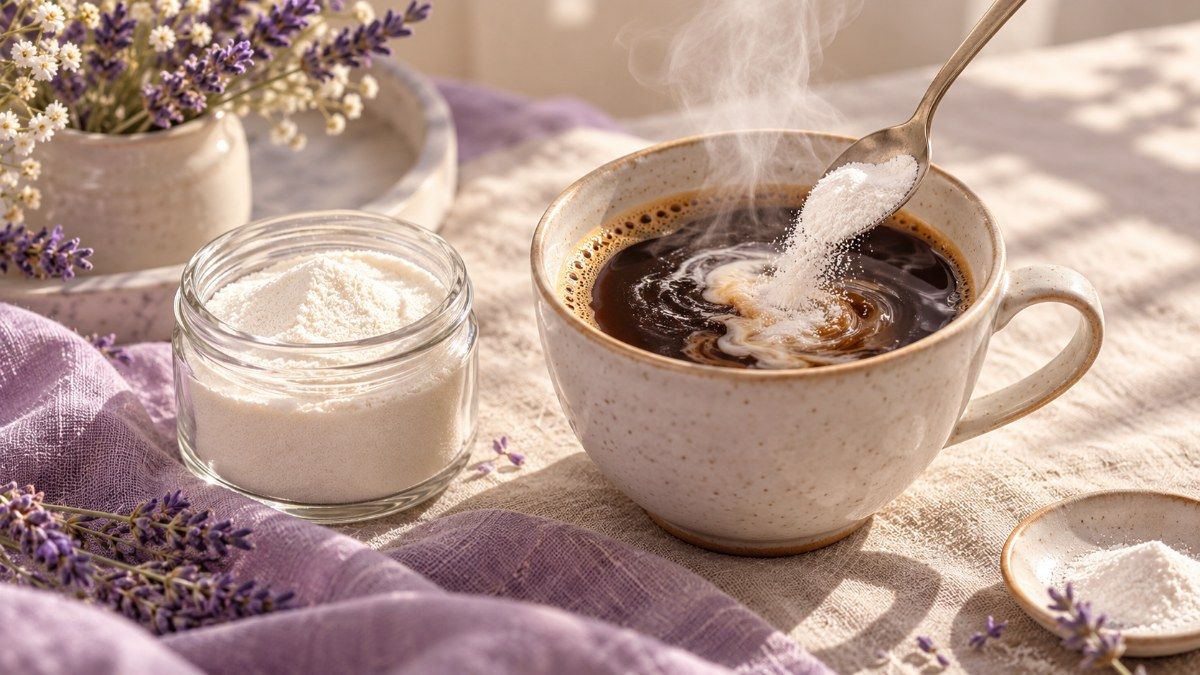
No, hot coffee does not destroy collagen peptides. The heat in a cup of coffee, about 90 to 96 °C when it is brewed and nearer 60 to 70 °C by the time you drink it, is lower than the temperatures used to make the powder in the first place: collagen is extracted from hides and bones in water that is taken close to boiling. What heat destroys is collagen's triple-helix structure, and that structure was already gone before the powder reached the tub, because 'peptides' means the collagen has been deliberately broken into short chains. Those chains are held together by peptide bonds, which need hours of strong acid at above 100 °C to break. So a scoop stirred into a morning coffee delivers the same amino acids and the same small peptides as a scoop stirred into cold water. The real questions are different ones: whether caffeine cancels out the benefit (probably not at normal intake), what the creamer and sugar add, and whether coffee is a good habit to hang a supplement on. This guide answers each, with the temperatures side by side.
Does Heat Destroy Collagen in Coffee? The Short Answer
- 1No. Collagen peptides are already denatured and hydrolysed; coffee-temperature water cannot 'denature' them further in any meaningful way.
- 2Manufacturing is hotter than your mug: extraction runs from about 50–60 °C in the first stage up to near boiling in the last.
- 3The bonds that matter, the peptide bonds holding amino acids together, survive boiling water. Breaking them in the lab takes strong acid at 110 °C for about a day.
- 4Native collagen in your body is a different story: its triple helix starts to unravel at around body temperature, which is why the supplement is sold pre-broken in the first place.
- 5Caffeine reduced collagen production in skin cells in a lab study, but only at concentrations roughly 20 to 500 times higher than coffee produces in the blood.
- 6Practical tips: stir into hot rather than iced coffee for easy dissolving, watch what the creamer adds, and keep the dose (10 to 15 g) consistent day to day.
What Heat Actually Does to Collagen
Collagen in skin, tendon and bone is a triple helix: three long protein chains wound around each other like a rope, stabilised by hydrogen bonds. Heat breaks those hydrogen bonds and the rope unwinds into single tangled chains, a process called denaturation. When cooks talk about collagen 'melting' in a slow-cooked stew, this is what they mean: the helix comes apart and the chains dissolve into the liquid as gelatin. The striking finding from a 2002 study in PNAS is how little heat this takes. Human type I collagen was found to be thermally unstable at body temperature itself; the helix survives in the body only because cells keep making and stabilising it. Denaturation is not destruction. The chains are still there, made of the same amino acids, and gelatin is simply collagen whose helix has unwound. The difference between collagen, gelatin and collagen peptides is explained in collagen vs collagen peptides.
Collagen peptides go one step further. After extraction, the gelatin is cut by enzymes into short chains, typically 2 to 5 kilodaltons, so the powder dissolves in cold water and does not gel. Nothing about that product depends on a helix. Its value, as far as the trials show, lies in the amino acids (glycine, proline and hydroxyproline in unusual amounts) and in small fragments such as prolyl-hydroxyproline that survive digestion and appear in the blood. Those fragments are held together by peptide bonds, which are chemically robust. The standard laboratory method for breaking proteins into single amino acids uses 6 molar hydrochloric acid at 110 °C for about 24 hours; a cup of coffee is nowhere near that. How the peptides are absorbed and what the trials measured is covered in what collagen peptides are.
The Temperatures, Side by Side
How hot is hot? Collagen temperatures compared
Inside the body
37 °C
Native type I collagen is at the edge of its stability; cells constantly rebuild it
Iced coffee
0–5 °C
No effect; peptides dissolve more slowly
Coffee as you drink it
60–70 °C
No effect on peptides; dissolves quickly
Brewing water
90–96 °C
No effect on peptide bonds
First extraction of gelatin at the factory
50–60 °C
Unwinds the helix; collagen becomes gelatin
Later extractions
Raised in steps toward boiling
Same; more gelatin released from the raw material
Drying the product
About 30–70 °C in drying zones
Removes water; peptides unchanged
Laboratory protein hydrolysis
110 °C in 6 M acid for ~24 hours
Breaks peptide bonds into single amino acids
The table makes the point better than any argument: the powder has already been through temperatures equal to or higher than your coffee during its own manufacture, and it came out as the product the trials tested. If coffee heat damaged collagen peptides, the manufacturing process would have damaged them first.
Where the '150 °C' Claim Comes From
Many articles on this topic, including the most-read one, say collagen begins to degrade at about 150 °C (302 °F) and conclude that coffee is safe because it is cooler. The conclusion is right but the number is borrowed from a different experiment. It comes from a 2011 study that heated dry collagen fibrils under an atomic force microscope and recorded thermal transitions at about 150 and 220 °C. That tells you how dry, intact fibrils behave on a hot plate, not what happens to dissolved peptides in a drink. The stronger argument is the chemical one above: peptides in water at any temperature a kettle can produce keep their peptide bonds. You do not need a 150 °C margin of safety; you need acid and a day in an oven, and coffee provides neither.
Does Caffeine Cancel Out Collagen?
This is the better question, and it has a real study behind it. In a 2014 laboratory study, researchers added caffeine to cultures of human skin fibroblasts, the cells that make collagen, and found that it reduced collagen production in a dose-dependent way, apparently by inhibiting an enzyme called prolidase that recycles proline for new collagen. The headline sounds alarming. The detail matters: the concentrations were 1, 2 and 5 millimolar. Drinking two or three cups of coffee produces blood caffeine levels of roughly 0.01 to 0.05 millimolar, so the lab cells were exposed to 20 to 500 times what reaches skin in a coffee drinker. No human study has shown that coffee drinkers absorb less collagen, make less collagen, or get less benefit from collagen supplements, and the skin and joint trials did not exclude coffee drinkers. The fair summary is that the mechanism is real in a dish at very high doses and unproven at normal intake. If you want to remove even the theoretical concern, take collagen with something other than coffee; if coffee is the habit that makes you take it every day, consistency matters more.
What You Add to the Coffee Matters More
- 1Sugar and syrups: a 15 g scoop of collagen adds about 55 calories; a flavoured syrup adds 80 to 100 more. In heated drinks, sugar and protein can undergo browning (Maillard) reactions, but at cup temperatures over a few minutes the effect on peptides is negligible.
- 2Creamers: some flavoured 'collagen creamers' contain only a few grams of collagen per serving, below the 2.5 to 15 g used in trials. Check the grams on the panel, not the claim on the front.
- 3Milk and plant milks: no interaction. Adding dairy protein to collagen actually improves the overall amino-acid profile, since collagen lacks tryptophan and is low in leucine, as explained in collagen peptides vs protein powder.
- 4Vitamin C: the body needs it to build collagen, but there is no reason it has to be in the same cup. An orange or a vitamin-C-rich breakfast works, as covered in collagen and vitamin C.
- 5Acidic cold brew or lemon: no effect on peptides at any realistic acidity or time.
How to Mix Collagen Into Coffee So It Actually Dissolves
Collagen peptides dissolve best in warm liquid, which is one practical reason coffee is popular. Add the powder to the empty cup first, pour a small amount of hot coffee over it and stir to a paste, then fill the cup; this prevents the clumps that form when powder lands on the surface of a full cup. A milk frother or a lidded shaker bottle works for iced coffee, where the powder dissolves more slowly. Unflavoured bovine and marine peptides are close to tasteless at 10 g; at 20 g some people notice a faint savoury note. Gelatin, by contrast, will thicken a drink as it cools and is not a substitute for peptides here. The full routine, including what to do if a scoop causes bloating, is in how to take collagen peptides.
Collagen in hot coffee vs other ways to take it
Hot coffee or tea
Fast
None
Easy daily habit; caffeine concern theoretical
Iced coffee or cold brew
Slow, may clump
None
Use a shaker or frother
Water or juice
Moderate
None
Vitamin C juice pairs well
Smoothie
Fast with blender
None
Easy to combine with whey or food protein
Soup or oatmeal (added at the end)
Fast
None
Adding during long boiling is also harmless to peptides
Baking
Mixed into batter
Peptides survive; some browning at crust temperatures
Fine, but dose per serving is hard to control
Is Collagen Coffee Worth It?
Collagen in coffee works exactly as well as collagen in anything else, which means it works as well as the trials suggest collagen works: modest improvements in skin hydration and elasticity after 8 to 12 weeks, less activity-related joint pain after 3 to 6 months, and better muscle and tendon gains when combined with training. The coffee neither adds to nor subtracts from that. Its real advantage is behavioural: a supplement attached to something you already do every morning gets taken, and every positive collagen trial depended on daily intake for weeks. Its real disadvantage is dose creep: pre-mixed collagen coffees and creamers often deliver a fraction of an effective dose. The timeline for each benefit is in how long collagen peptides take to work, and what the skin trials actually measured is in collagen for skin, hair and nails.
Who Should Be Careful
- 1People sensitive to caffeine who are adding collagen to a second or third cup they would not otherwise drink
- 2People with reflux, where coffee is the trigger and the collagen is incidental
- 3Anyone using sweetened collagen creamers daily, where the sugar outweighs the collagen
- 4People with fish or bovine allergies, who should check the source on the label as described in how to choose collagen peptides
- 5Anyone taking more than one collagen product (a creamer plus a powder plus a gummy) without adding up the total; the practical ceiling is covered in can you take too many collagen peptides
When to Talk to Your Doctor
- 1If you have kidney disease and are adding 10 to 20 g of protein a day on top of your usual intake
- 2If collagen in coffee causes persistent bloating, heartburn or diarrhea; the full list of side effects is on our collagen side effects page
- 3If you are pregnant or breastfeeding and want to take collagen alongside caffeine; total caffeine limits still apply
- 4If you take medicines that interact with caffeine, such as certain antidepressants or theophylline
The Bottom Line
Hot coffee does not destroy collagen peptides. The helix that heat can unravel was removed during manufacturing, at temperatures as high as your coffee or higher, and the peptide bonds that hold the useful fragments together survive anything a kettle can do. The caffeine concern comes from a cell-culture study at doses far above what coffee produces in the body, and no human study has shown a problem. If coffee is how you remember to take 10 to 15 g every day, it is a perfectly good vehicle; just check that the creamer or ready-mixed product actually contains a meaningful dose.
FAQ
No. Collagen peptides are already denatured and cut into short chains during manufacturing, which uses water close to boiling. Coffee at 60 to 96 °C does not break the peptide bonds that hold the useful fragments together.
Native collagen's triple helix starts to unwind at around body temperature, which is why supplements are sold pre-hydrolysed. The peptide bonds in collagen peptides are far more stable: breaking them in the lab takes strong acid at 110 °C for about 24 hours.
In a 2014 cell-culture study, caffeine reduced collagen production in skin fibroblasts, but at 1 to 5 millimolar, roughly 20 to 500 times the blood levels that coffee produces. No human study has shown that coffee reduces the benefit of collagen supplements.
It makes no difference to the peptides. Hot drinks dissolve the powder faster; in cold drinks, use a shaker or frother to avoid clumps.
Yes. Daily intake is what the positive trials used, and a coffee habit makes consistency easier. Keep the dose at 10 to 15 g and check creamers, which often contain far less collagen than their labels imply.
As well as collagen in any other drink. The skin trials used 2.5 to 10 g a day for 8 to 12 weeks; the vehicle was not what mattered.
Sources
- 1Leikina E et al. Type I collagen is thermally unstable at body temperature, Proceedings of the National Academy of Sciences, 2002
- 2Bozec L, Odlyha M. Thermal denaturation studies of collagen by microthermal analysis and atomic force microscopy, Biophysical Journal, 2011
- 3Influence of caffeine and hyaluronic acid on collagen biosynthesis in human skin fibroblasts, Drug Design, Development and Therapy, 2014
- 4Gelatin process diagram description, Toxics Use Reduction Institute, University of Massachusetts Lowell, 2021
- 5de Miranda RB et al. Effects of hydrolyzed collagen supplementation on skin aging: a systematic review and meta-analysis, International Journal of Dermatology, 2021
- 6Spilling the beans: how much caffeine is too much?, U.S. Food and Drug Administration
This article summarizes published research for general information. It does not recommend any product.

Dimitrun Irene
Author
Comments (0)
Be the first to comment on this article.
More articles