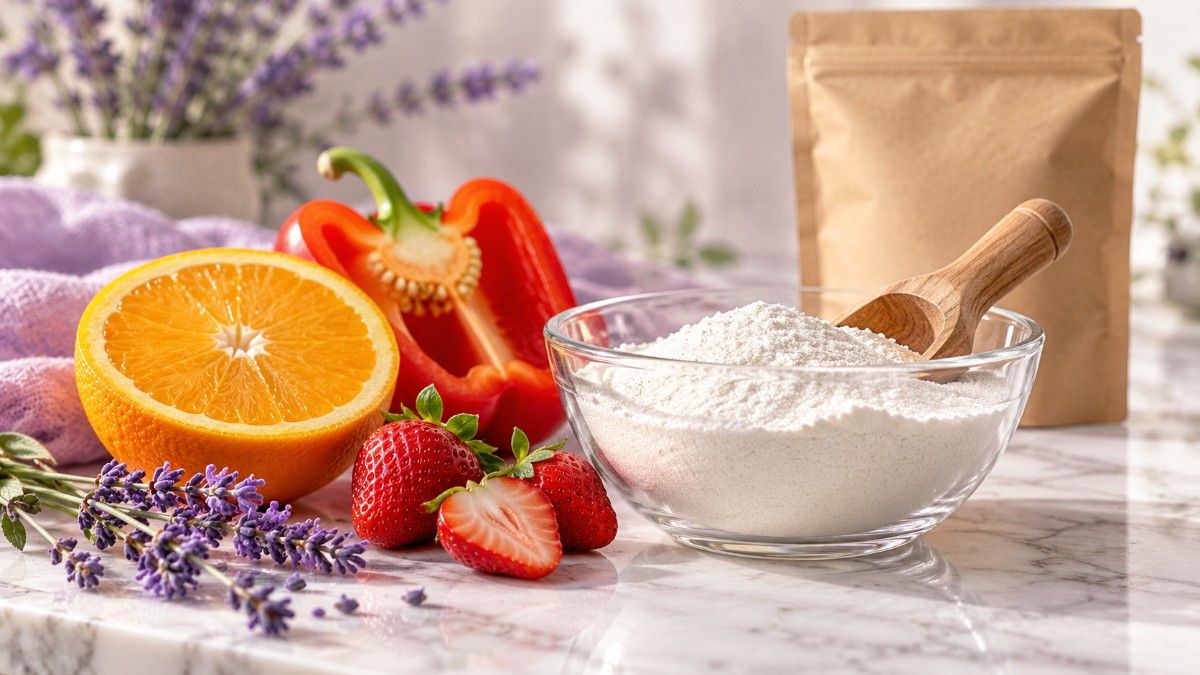
Collagen and Vitamin C: Do You Need Both, and Do You Need Them Together?
You need vitamin C to make collagen, but not with your collagen scoop. How they work together, what the 2024 trial found, how much is enough, and who is short.
Written by Dimitrun Irene. Updated October 24, 2026.
You need vitamin C to make collagen, but you do not need to take vitamin C at the same moment you take collagen peptides. Vitamin C is a required helper for the enzymes that lock collagen into its stable triple-helix shape; without it the body cannot build collagen at all, which is why scurvy causes bleeding gums and wounds that will not heal. The amount needed for that job is small, about 75 to 90 mg a day, and most people get it from food. Collagen supplements with "added vitamin C" are not wrong, but the vitamin is doing a background job, not supercharging the powder.
Here is how the two actually work together inside the body, what the one trial that tested collagen plus vitamin C found, who is genuinely short of vitamin C, how much is enough, and whether the combination products are worth paying for.
Collagen and Vitamin C: The Short Answer
- 1Vitamin C is a cofactor for the enzymes (prolyl and lysyl hydroxylase) that make collagen stable. No vitamin C, no usable collagen.
- 2Collagen peptides supply the building blocks (glycine, proline, hydroxyproline); vitamin C helps the body assemble them. They work at different steps, not as a pair.
- 3Timing does not matter. Vitamin C from breakfast still supports collagen made at midnight. Taking them together is convenient, not necessary.
- 4The daily need is modest: 75 mg for women, 90 mg for men, plus 35 mg for smokers. One orange or half a bell pepper covers it.
- 5A 2024 placebo-controlled trial of 5 g collagen plus 80 mg vitamin C improved skin density by about 16% over 16 weeks; trials of collagen alone have shown similar results, so the vitamin C was likely not the active difference.
- 6Who should pay attention: smokers, people who eat few fruits and vegetables, heavy drinkers, people with malabsorption, and anyone healing from surgery or injury.
What Vitamin C Actually Does for Collagen
Collagen is made inside cells as a long chain of amino acids rich in proline and lysine. Before three of those chains can twist together into the strong triple helix that gives skin, tendons and bone their structure, some of the proline and lysine must be converted to hydroxyproline and hydroxylysine. The enzymes that do this, prolyl hydroxylase and lysyl hydroxylase, need vitamin C (ascorbic acid) and iron to work. Vitamin C keeps the iron in the enzyme in its active form.
When vitamin C is missing, the chains are made but cannot be hydroxylated, so they fail to form a stable helix and are broken down. That is scurvy: old scars reopen, gums bleed, hair grows in corkscrews and small blood vessels leak. Vitamin C also appears to switch on collagen gene activity in skin cells and protects collagen from damage by free radicals, which is why it shows up in both supplements and skin creams. For how collagen itself is built and broken down, see what collagen peptides are.
What Collagen Peptides Do, and Why They Are a Different Step
Collagen peptides are collagen that has been broken into short chains by enzymes. When you drink them, digestion breaks most of them down further into amino acids and small dipeptides such as prolyl-hydroxyproline, which are absorbed into the blood. Those pieces do two things: they supply the raw materials for new collagen, and, according to cell and animal studies, they act as a signal that nudges skin and cartilage cells to make more collagen and hyaluronic acid.
So collagen peptides provide the bricks and part of the instruction; vitamin C makes sure the bricklaying enzymes function. If either is missing the process stalls, but adding more of one does not make the other work harder. Someone with plenty of vitamin C gains nothing from an extra 100 mg in their collagen tub; someone who is deficient will not fix that by drinking more collagen.
Do You Need to Take Collagen and Vitamin C Together?
No. The hydroxylation step happens inside cells hours or days after you eat, using the vitamin C already circulating. Vitamin C is water-soluble and the body holds a pool of about 1.5 g in tissues; a daily intake from food keeps that pool topped up. Whether you take your collagen with orange juice or on its own, the vitamin C from any meal that day is available when the collagen is assembled.
The case for taking them together is purely practical. If a scoop of collagen with added vitamin C is the one supplement you reliably take, you have covered both bases. If you eat fruit and vegetables, the vitamin C in the tub is surplus. Our guide to how to take collagen peptides covers timing, dose and what to mix it with.
What the Trials Show
Key trials of collagen with or without vitamin C
Nutrients 2024 (Slovenia), 87 women aged 40 to 65
5 g bovine collagen peptides + 80 mg vitamin C daily, with or without 30 mg hyaluronic acid, vs placebo
16 weeks
Dermis density up about 16% vs placebo; wrinkle depth down 17% to 19%; roughness down about 10%. No benefit from adding hyaluronic acid. Hydration and elasticity not significantly changed.
Proksch 2014 (Germany), 69 women aged 35 to 55
2.5 g or 5 g collagen peptides alone vs placebo
8 weeks
Elasticity improved significantly in both collagen groups; no vitamin C added.
Bolke 2019 (Germany), 72 women aged 35+
2.5 g collagen peptides with vitamin C, zinc, biotin and vitamin E vs placebo
12 weeks
Hydration, elasticity, roughness and density all improved vs placebo.
2021 meta-analysis of 19 trials, 1,125 participants
Hydrolyzed collagen, various products, some with vitamin C
Up to 90 days
Significant improvement in skin hydration and elasticity overall.
The 2024 trial is the one that ranks for this question, and it is a well-run study, but it did not include a collagen-only arm, so it cannot say whether the vitamin C added anything. Trials that used collagen alone, such as Proksch 2014, found comparable effects. The honest reading is that collagen peptides work in people who already have enough vitamin C, and no trial has shown extra benefit from adding more. The detail for skin, hair and nails is in collagen for skin, hair and nails, and for joints in collagen for joints and exercise.
How Much Vitamin C Do You Need?
Vitamin C: needs and sources
Daily recommended intake, adult women
75 mg
Daily recommended intake, adult men
90 mg
Extra for smokers
+35 mg
Pregnancy / breastfeeding
85 mg / 120 mg
Upper limit (above this, diarrhea and kidney stone risk)
2,000 mg
Half a cup of raw red bell pepper
About 95 mg
One medium orange
About 70 mg
Half a cup of strawberries
About 50 mg
Half a cup of cooked broccoli
About 50 mg
One kiwi
About 65 mg
Typical amount added to a collagen scoop
60 to 100 mg
Tissue saturation is reached at roughly 200 mg a day from food; beyond that, extra vitamin C is simply excreted. Megadoses of 1,000 mg or more do not build more collagen. Heat and long storage destroy some vitamin C, so raw or lightly cooked produce delivers more than boiled.
Who Is Actually Short of Vitamin C?
Outright deficiency is uncommon in high-income countries but not rare: U.S. survey data put it at around 6% to 7% of adults, with low-but-not-deficient levels in many more. The groups most likely to be short are smokers (smoke uses up vitamin C quickly), people who eat little fruit and vegetables, heavy drinkers, people with inflammatory bowel disease or after bariatric surgery, people on dialysis, and older adults living alone. In these groups a collagen product with added vitamin C, or a separate vitamin C supplement, makes real sense. For everyone else, food covers it.
Signs worth noticing: easy bruising, bleeding gums, slow-healing cuts, rough bumpy skin on the arms, fatigue and joint aches. A blood test for plasma ascorbic acid is available if you or your doctor suspect a problem.
Is Collagen With Added Vitamin C Worth Buying?
- 1If you already eat fruit and vegetables daily: the added vitamin C is harmless but adds nothing. Choose the collagen on the merits in how to choose collagen peptides: hydrolyzed, 2.5 to 10 g per serving, third-party tested.
- 2If your diet is low in produce, or you smoke: the combination is a reasonable way to cover a real gap. Check that the vitamin C dose is at least 60 mg.
- 3If you are healing from surgery or an injury: vitamin C needs rise, and some surgeons recommend 500 mg a day short term alongside protein; ask yours.
- 4Avoid paying extra for "vitamin C enhanced" claims that imply better absorption; vitamin C does not change how collagen peptides are absorbed.
- 5Watch for products that pad the vitamin C to 500 to 1,000 mg; it is not harmful, but high doses can cause stomach upset and the collagen is doing the work.
Side Effects and Interactions
Collagen peptides are well tolerated; the main complaints are fullness, mild bloating and an aftertaste. Vitamin C at food-level doses has no meaningful side effects. At supplement doses above about 1,000 mg it can cause diarrhea, nausea and, in people prone to them, kidney stones, and it increases iron absorption, which matters for anyone with hemochromatosis. Vitamin C can also interfere with some blood glucose meters and lab tests at high doses. See our side effects page for collagen specifically.
When to Talk to Your Doctor
- 1You have bleeding gums, unexplained bruising or wounds that heal slowly
- 2You have a condition that affects absorption (celiac, Crohn's, bariatric surgery) or you are on dialysis
- 3You have kidney stones or hemochromatosis and are considering high-dose vitamin C
- 4You are planning surgery and want to support healing
- 5You take warfarin or chemotherapy, where high-dose vitamin C can interfere
If you are over 60, the choice between products matters less than dose, hydrolysis and consistency; our guide to collagen for women over 60 goes through what the research supports at that age and what it does not.
If you also take a probiotic, timing and compatibility are covered in can you take collagen and probiotics together.
The vitamin C and collagen protocol used before exercise in tendon research is explained in collagen for tendons and ligaments.
The Bottom Line
Collagen and vitamin C are partners in the sense that the body cannot make collagen without vitamin C, not in the sense that they must be swallowed together. Get your vitamin C from a normal diet, or from a supplement if you smoke or eat few plants, and choose collagen peptides for what they are: a reliable source of the amino acids and peptides that have improved skin density, elasticity and joint comfort in trials with or without added vitamin C. The combination tubs are fine; the combination claim is oversold. For how long results take, see how long collagen peptides take to work.
FAQ
No. Vitamin C does not affect how collagen peptides are absorbed. It is needed later, inside cells, for the enzymes that build new collagen from the absorbed amino acids.
You can, but it is not necessary. Vitamin C from any meal that day supports collagen synthesis. Taking them together is convenient if a combined product is your routine.
The normal daily intake, 75 mg for women and 90 mg for men (plus 35 mg for smokers), is enough. Tissues are saturated at about 200 mg a day; higher doses do not make more collagen.
Vitamin C is essential for collagen production and protects existing collagen from oxidative damage, but once you have enough, more vitamin C does not increase collagen. Deficiency, not surplus, is what limits collagen.
Not for most people. Trials of collagen alone show similar skin results to trials of collagen with vitamin C. The added vitamin C helps only if your diet is short of it.
Sources
- 1The Effects of Dietary Supplementation with Collagen and Vitamin C and Their Combination with Hyaluronic Acid on Skin Density, Texture and Other Parameters, Nutrients, 2024
- 2Oral supplementation of specific collagen peptides has beneficial effects on human skin physiology (Proksch), Skin Pharmacol Physiol, 2014
- 3A Collagen Supplement Improves Skin Hydration, Elasticity, Roughness, and Density (Bolke), Nutrients, 2019
- 4Effects of hydrolyzed collagen supplementation on skin aging: a systematic review and meta-analysis, Int J Dermatol, 2021
- 5Vitamin C: Fact Sheet for Health Professionals, NIH Office of Dietary Supplements
- 6The Roles of Vitamin C in Skin Health, Nutrients, 2017
- 7Vitamin C deficiency in the United States (NHANES), Am J Clin Nutr, 2009
This article is for general information and does not replace advice from a doctor, pharmacist or dietitian.

Dimitrun Irene
Author
Comments (0)
Be the first to comment on this article.
More articles