Collagen and Turmeric: Should You Take Them Together?
Collagen and turmeric can be taken together, but no published trial of the pair was found. Joint evidence for each, liver and warfarin warnings.
Written by Dimitrun Irene. Updated November 20, 2026.
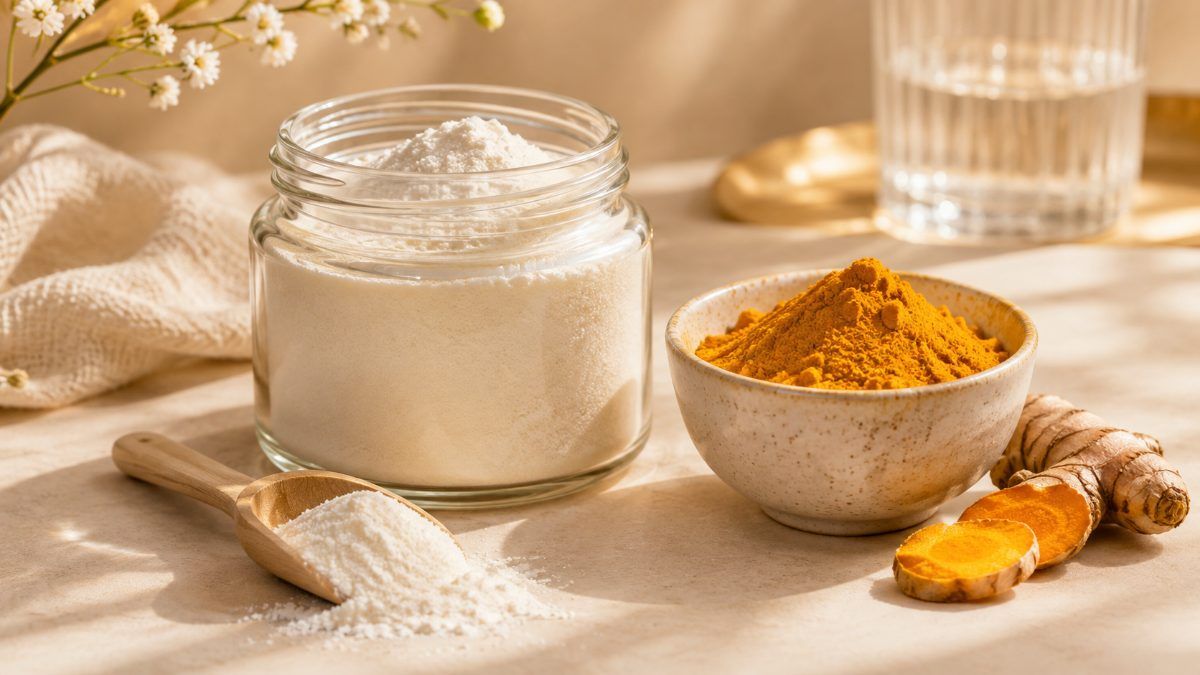
You can take collagen and turmeric together, as no interaction between them has been reported, but we found no published trial of the combination, so there is no evidence that they work better together than apart. Each one on its own has only weak evidence for knee osteoarthritis (OA), the common "wear and tear" arthritis in which joint cartilage breaks down. Reviews of curcumin, the main active compound in turmeric, and of collagen both report small improvements in pain scores, but the trials behind them are mostly small and of low quality. The bigger question is safety, and it concerns turmeric rather than collagen: the US National Center for Complementary and Integrative Health (NCCIH) notes that liver damage has been reported in some people taking highly bioavailable curcumin supplements, and New Zealand's medicines regulator, Medsafe, warns that turmeric products can interact with the blood thinner warfarin. This guide covers what the research shows for each, why "synergy" claims are untested, the safety warnings, and what to ask your doctor.
Collagen and Turmeric Together: The Short Answer
- 1No published trial of collagen peptides plus turmeric or curcumin was found, as of November 2026.
- 2Curcumin and collagen each show small benefits for knee OA pain in reviews, but the evidence is low quality.
- 3No interaction between collagen and turmeric is known; claims of "synergy" are untested.
- 4Turmeric supplements have been linked to rare cases of liver injury, including one death in a US case series.
- 5Turmeric can interact with warfarin, according to New Zealand's regulator Medsafe.
- 6Turmeric supplements may be unsafe in pregnancy, according to NCCIH.
Is There Any Research on Collagen and Turmeric Taken Together?
No. We found no published trial of collagen peptides combined with turmeric or curcumin. That absence does not prove no study exists, but it means the many websites promoting the pair are not drawing on direct evidence. A large 2025 network meta-analysis, a type of review that compares several treatments at once, deliberately excluded combination products, so it tells us nothing about the pair either.
The closest study we found is a registered trial at Taipei Medical University (NCT06581094). It tested a mix of 42 mg undenatured type II collagen (UC-II), 460 mg glucosamine and 380 mg curcumin against a control in 32 people with knee pain. It is listed as completed, but we found no results, and the registry entry is inconsistent about what the control group took. UC-II is also a different product from the collagen peptides most people buy; the difference is explained in undenatured type II collagen.
Does Turmeric Help Joint Pain?
Possibly a little, for knee osteoarthritis. A 2022 meta-analysis in BMC Complementary Medicine and Therapies pooled 15 randomized trials with 1,670 patients. Compared with placebo, curcuminoids lowered pain on a visual analogue scale (VAS, a line on which people mark how bad their pain is) by a weighted mean difference of 1.77 and improved the WOMAC total score (a questionnaire of pain, stiffness and function) by about 7 points. There was no significant increase in side effects, and curcumin did not perform worse than anti-inflammatory painkillers (NSAIDs). However, the authors flagged low-quality studies and substantial variation between trials.
A 2024 umbrella review in Phytotherapy Research, which looked across 11 meta-analyses, also found improvements in VAS and WOMAC scores. NCCIH sums this up cautiously: the knee OA meta-analyses look positive, but higher-quality evidence is needed.
Does Collagen Help Joint Pain?
Also possibly a little, with similar caveats. A 2023 meta-analysis by Lin and colleagues in the Journal of Orthopaedic Surgery and Research pooled 4 randomized trials of collagen peptides with 507 knee OA patients and found a moderate reduction in pain (a standardized mean difference of -0.58). But all 4 trials were judged at high risk of bias, and the results varied considerably between them. Our full review of collagen for knee osteoarthritis looks at the trials and who funded them, and collagen peptides for joints and exercise covers wider joint research.
How Do Curcumin and Collagen Compare for Knee Osteoarthritis?
The 2025 network meta-analysis by Zhang and colleagues in Nutrients is useful here because it compared seven supplements against placebo in the same analysis: 39 trials with 4,599 patients. Curcumin (8 studies) and collagen (5 studies) both improved physical function and pain, by broadly similar amounts. Neither improved all four outcomes the authors measured; only boswellia, another plant extract, did. No supplement increased side effects compared with placebo.
Knee osteoarthritis evidence snapshot: curcumin, collagen and the combination
Curcumin
BMC Complement Med Ther 2022
15 RCTs, 1,670 patients
VAS pain -1.77; WOMAC total -7.06
Low-quality studies; substantial heterogeneity
Curcumin
Zhang 2025, Nutrients (network meta-analysis)
8 studies within 39 RCTs, 4,599 patients
Function MD 9.96; VAS pain MD 12.34
Significant on 2 of 4 outcomes
Collagen
Lin 2023, J Orthop Surg Res
4 RCTs, 507 patients
Pain SMD -0.58
All 4 trials high risk of bias; I² 68%
Collagen
Zhang 2025, Nutrients (network meta-analysis)
5 studies within 39 RCTs, 4,599 patients
Function MD 9.42; VAS pain MD 16.65
Significant on 2 of 4 outcomes
Collagen plus turmeric
None found
No trials found
Unknown
One related trial (UC-II + glucosamine + curcumin) has no published results
MD means mean difference and SMD means standardized mean difference; both describe the average gap between supplement and placebo groups. I² measures how much trials disagree with each other, and higher values mean less consistent results.
Would Combining Collagen and Turmeric Work Better?
Nobody knows. The idea sounds logical: curcumin is studied for inflammation and collagen is a building block of connective tissue, so together they might cover more ground. But plausible ideas often fail in trials, and two weak effects do not necessarily add up. Without a study that compares the combination with each supplement alone, any claim of "synergy" or extra benefit is marketing rather than evidence.
We also found no evidence either way that turmeric interferes with collagen absorption, or that it boosts the body's own collagen production in people. If you see those claims, ask for the human study behind them.
Can Turmeric Supplements Harm Your Liver?
Rarely, yes. NCCIH, part of the US National Institutes of Health, states that highly bioavailable curcumin formulations may harm the liver and that liver damage has been reported in some people who took them. Two sets of reports stand out:
- 1US Drug-Induced Liver Injury Network (DILIN), published 2023: 10 cases of turmeric-associated liver injury between 2004 and 2022, all after 2011. Five people were hospitalized and one died. Seven of the 10 carried a gene variant called HLA-B*35:01. Other medicines were involved in many cases, so turmeric was not proven to be the sole cause.
- 2Australia's Therapeutic Goods Administration (TGA), 2023: 18 reports between September 2002 and June 2023, of which 9 suggested possible liver injury and 1 was fatal. The TGA proposed a label warning that, in rare cases, Curcuma species may harm the liver.
NCCIH advises stopping turmeric or curcumin products immediately and contacting a health care provider if you develop fatigue, nausea, poor appetite, dark urine or yellowing of the skin or eyes (jaundice). If you are worried about collagen itself, our article on whether collagen is bad for your liver covers that separately.
Turmeric safety signals
NCCIH (US National Institutes of Health)
Last updated April 2025
Highly bioavailable curcumin may harm the liver; liver damage reported; piperine is one way to raise absorption; may be unsafe in pregnancy
DILIN case series (Am J Med)
2023
10 liver injury cases (2004 to 2022); 5 hospitalized, 1 death; 7 of 10 carried HLA-B*35:01
TGA (Australia)
2023
18 reports (2002 to June 2023); 9 suggested possible liver injury; 1 fatal; label warning proposed
Medsafe (New Zealand)
December 2022
Turmeric products can interact with warfarin; 3 national reports of warfarin-turmeric interaction
Does Black Pepper (Piperine) Make Turmeric Riskier?
It may. Curcumin is poorly absorbed from the gut, so many supplements are sold as "highly bioavailable", meaning they are designed to raise blood levels, often by adding piperine from black pepper. NCCIH warns that highly bioavailable curcumin formulations may harm the liver, and it names combining curcumin with piperine as one way to raise bioavailability. More absorption is not automatically better: it may also mean more exposure to whatever causes the rare liver reactions. If you choose a turmeric supplement, check the label for piperine or "enhanced absorption" claims and discuss them with your doctor.
Which Medicines Can Turmeric Interact With?
The best-documented interaction is with warfarin, a blood thinner. In a December 2022 Prescriber Update, New Zealand's Medsafe stated that turmeric and curcumin-containing products can interact with warfarin, and described a case in which a patient's INR (a blood test that measures how long blood takes to clot) spiked while taking a turmeric tonic and eating a diet high in turmeric. Medsafe had received 3 reports of warfarin-turmeric interaction among 236 warfarin interaction reports up to September 2022.
NCCIH gives a general warning that turmeric may interact with medicines but does not name specific drugs. We did not find a regulator source on interactions with other anticoagulants or antiplatelet drugs, which does not mean they are safe together. If you take any blood thinner or several prescription medicines, ask your pharmacist before starting turmeric. No interactions between collagen and medicines were identified in the sources for this article; general collagen tolerability is covered in collagen peptides side effects.
Who Should Avoid Turmeric Supplements?
- 1People taking warfarin or other blood thinners, unless their doctor agrees and monitors them
- 2Pregnant people: NCCIH says turmeric supplements may be unsafe in pregnancy; collagen in pregnancy is covered in collagen during pregnancy and breastfeeding
- 3Breastfeeding people: NCCIH notes little is known about amounts above those in food
- 4People with liver disease or a past reaction to turmeric
- 5Anyone who develops fatigue, nausea, dark urine or jaundice while taking it, who should stop and seek care
The HLA-B*35:01 finding in the DILIN series suggests some people may be genetically more susceptible, but this is not something most people know about themselves, and it is not a routine test before taking supplements.
Is Turmeric in Food Different From Turmeric Supplements?
The safety warnings in this article concern supplements, not curry. NCCIH's concerns centre on supplements and especially on formulations designed to boost absorption, and its pregnancy and breastfeeding cautions refer to amounts above those found in food. The liver injury reports also involved supplements and products such as tonics. We found no evidence that adding turmeric to your cooking alongside a collagen drink causes harm for most people. One exception to keep in mind: the Medsafe warfarin case involved a turmeric-rich diet as well as a tonic, so if you take warfarin, ask your doctor before making large changes to how much turmeric you eat.
When to Talk to Your Doctor
- 1Before starting turmeric if you take warfarin, another blood thinner or several prescription medicines
- 2If you are pregnant, trying to conceive or breastfeeding
- 3If you have liver disease or have had abnormal liver tests
- 4Straight away if you develop fatigue, nausea, poor appetite, dark urine or yellow skin or eyes
- 5If joint pain is new, severe, getting worse, or comes with a hot, swollen joint
What to Do Next: Questions to Ask Your Doctor
If you are thinking of trying collagen, turmeric or both for joint pain, a careful approach looks like this:
- 1Check every medicine you take with a pharmacist before adding turmeric.
- 2Read labels for piperine or "high absorption" claims, and for extra ingredients in blended products.
- 3Start one supplement at a time so you can tell what, if anything, helps or causes side effects.
- 4Record your pain on a 0 to 10 scale before starting and monthly afterwards; collagen trials typically ran for months, as explained in how long collagen peptides take to work.
- 5Pick third-party tested products; see how to choose collagen peptides.
- 6Ask: Is turmeric safe with my medicines? Should my liver tests or INR be checked? Is my joint pain osteoarthritis or something else? Which exercises or treatments would help my knees most?
The Bottom Line
Collagen and turmeric can be taken together, but we found no published trial of the pair, so there is no evidence of extra benefit from combining them. Each has small, low-quality evidence for knee osteoarthritis pain on its own. Turmeric supplements, unlike turmeric in food, carry rare but serious liver risks and can interact with warfarin. If you want to try them, talk to your doctor or pharmacist first, especially if you take a blood thinner, are pregnant or have liver problems.
FAQ
Yes, no interaction between them is known. But we found no published trial of the combination, so there is no evidence that they work better together than separately.
Turmeric in food is generally not a concern. Supplements have been linked to rare liver injury, and NCCIH says they may be unsafe in pregnancy. Ask your doctor first.
We found no evidence either way. No human study has tested whether turmeric affects how collagen is absorbed.
Medsafe in New Zealand warns that turmeric products can interact with warfarin. Talk to your doctor before taking turmeric with any blood thinner.
Rarely. US and Australian reports describe liver injury linked to turmeric supplements, including a small number of deaths. Stop and seek care if you develop dark urine or jaundice.
Piperine from black pepper boosts curcumin absorption, and NCCIH warns that highly bioavailable curcumin formulations may harm the liver. Ask your doctor first.
Sources
- 1Meta-analysis of curcuminoids for knee osteoarthritis (DOAJ record), BMC Complementary Medicine and Therapies, 2022
- 2Bideshki MV et al. Umbrella review of curcumin meta-analyses in osteoarthritis (record), Phytotherapy Research, 2024
- 3Zhang Y et al. Network meta-analysis of seven supplements for knee osteoarthritis, Nutrients, 2025
- 4Lin CR et al. Meta-analysis of collagen peptides for knee osteoarthritis (record), Journal of Orthopaedic Surgery and Research, 2023
- 5Registry listing for NCT06581094: UC-II, glucosamine and curcumin for knee pain, Taipei Medical University trial record
- 6Turmeric fact sheet, National Center for Complementary and Integrative Health, 2025
- 7Prescriber Update article on warfarin interactions, including turmeric, Medsafe New Zealand, 2022
- 8News report on the DILIN turmeric liver injury case series, Medical News Today, 2023
- 9Trade press report on the TGA turmeric and curcumin liver injury advisory, NutraIngredients, 2023
This article summarizes published research for general information and is not medical advice. Neither collagen nor turmeric is an approved treatment for osteoarthritis, and no dosing recommendation is given here.

Dimitrun Irene
Author
Comments (0)
Be the first to comment on this article.
More articles