Does Collagen Expire? Shelf Life, Storage and Signs It's Gone Bad
Collagen can degrade, mainly from moisture and heat. What US law says about supplement dates, how to store collagen and when to throw it out.
Written by Dimitrun Irene. Updated November 10, 2026.
Yes, collagen can expire, but in a dry, sealed container it is a very stable product, and what usually ruins it is moisture, heat and contamination rather than the passing of a date. Collagen supplements are collagen peptides, small pieces of protein made from animal skin, bones or fish scales. In the United States, no federal rule requires a supplement to carry an expiration or "best by" date at all. If a company does print one, the FDA says it should have data to support it. Ingredient makers report about five years for sealed bulk collagen peptides, but a tub you open daily is different. Studies of other protein powders show that once they absorb water they clump, darken and pick up off smells. The practical rule is simple: follow the date and storage directions on your label, keep the container cool, dry and tightly closed, and throw the product out if it is hard-clumped, smells wrong, has changed colour or the packaging is damaged.
Does Collagen Expire? The Short Answer
- 1Expiry dates are not required: US law does not require supplements to carry one, but a printed date should be backed by data.
- 2Dry collagen is stable: ingredient makers report about 5 years for sealed, unopened bulk peptides kept away from heat and moisture.
- 3Moisture is the main threat: protein powders that absorb water clump, turn sticky, darken and develop new odours.
- 4Opened products: no independent study sets a time limit after opening, so follow the label.
- 5Discard it if it is hard-clumped, smells sour or musty, is discoloured or moldy, or the seal or packaging is damaged.
- 6Store it cool, dry and sealed, with a dry scoop, away from the stove, kettle and dishwasher.
Does Collagen Actually Expire?
Collagen peptides are a dry protein powder with very little water in them, and dry foods give bacteria, yeasts and molds little chance to grow. Rousselot states that its Peptan B 2000 LD ingredient "will maintain its initial properties for at least 5 years" in its original unopened packaging, and advises storing it "away from heat and moisture." GELITA states that its PEPTIPLUS XB peptides keep "at ambient temperatures (< 30°C) for 5 years without loss of quality" when unopened. These are manufacturer figures, not independent studies, and they describe raw ingredient in sealed industrial bags. An opened tub lets in humid air at every use, and flavourings or sweeteners can change how a product ages. So collagen does not "go off" on a set day, but it can degrade, and how you store it matters more than the date. For a refresher on what these peptides are, see what are collagen peptides.
Are Expiration Dates on Supplements Required by Law?
No. The FDA's compliance guide for supplement manufacturing answers "No" to the question of whether a supplement must carry an expiration, shelf-life or "best if used by" date, citing the 2007 Current Good Manufacturing Practice (CGMP) rule for supplements. The same guide says a company "should have data to support any such date that you place on a product label." In other words, a printed date is optional, but it is not supposed to be a guess.
Makers must hold ingredients and finished products "under appropriate conditions of temperature, humidity, and light," and keep reserve samples for one year past the shelf-life date if they use one, or two years from distribution of the last batch if not. Drugs are different: according to a trade-association comparison of the two rules, drug makers must run stability programs and use expiration dates, with no matching requirement for supplements. In 2011 NSF International published a voluntary stability testing guideline for supplements. Trade press reported that if a label carries an expiration or best-by claim, the FDA expects to see supporting stability data during inspections.
A "best by" date usually refers to quality, such as taste and mixability, while an "expiration" date usually marks how long the company expects the product to meet its label claims. Either way, follow what your label says. A product with no date at all is legal, and checking for testing and quality marks is covered in how to choose collagen peptides.
How Long Does Collagen Last, Unopened vs Opened?
The only figure that applies to your container is the one on its label. The table separates what is documented from what is not.
Collagen shelf life by format: what is documented (as of November 2026)
Bulk collagen peptide ingredient (sealed, unopened)
At least 5 years (Rousselot); 5 years below 30°C (GELITA), manufacturer data
Not applicable
Heat and moisture
Powder tub or pouch
Whatever the label states; no federal minimum or maximum
No independent figure; follow the label
Humidity, wet scoops, heat
Gummies
About 2 years for most gummies, according to a supplement maker quoted in trade press
Follow the label
Heat (gelatin gummies melt at lower temperatures), potency loss
Liquid collagen
Whatever the label states
No independent figure; refrigerate if the label says so
Microbial growth once opened, heat
Capsules
Whatever the label states
Follow the label
Humidity
You may see specific "months after opening" figures online. We could not find any independent source for them; they appear only on seller websites, so we have not repeated them here. How the formats compare in other ways is covered in liquid collagen vs powder and collagen powder vs capsules.
What Makes Collagen Powder Go Bad?
No study has tracked consumer collagen tubs over time, so the best evidence comes from research on similar protein powders. Treat these findings as a guide to what can happen to protein powders in general, not as measurements of collagen products.
- 1Moisture and caking: protein hydrolysates, which is what collagen peptides are, attract water more readily than intact protein. Smaller fragments make a powder turn sticky more easily, which drives caking.
- 2Humidity damage: in a study of hydrolysed egg-white powder stored at 45°C for two months, the powder became sticky, clumped and collapsed at water activity levels of 0.43 to 0.79, with significant quality loss above 0.31. Water activity is a 0-to-1 measure of how much free water a food holds.
- 3Browning: in that same study, colour changes matched the Maillard reaction, a browning reaction between protein and sugars, driven by a small amount of glucose.
- 4Fast changes in humid air: shrimp peptide flour kept at 25°C and 75% relative humidity for 30 hours darkened, became sticky, partly liquefied and developed new odour compounds.
- 5Added sugars: tilapia-skin collagen peptides heated with the sugars ribose and glucosamine browned strongly, but barely changed with glucose. So collagen can brown, especially in sweetened blends kept warm or humid.
- 6Contamination: a wet scoop, damp fingers or steam from a kettle all add water, and water is what allows microbes to grow.
The FDA notes that most fresh foods have a water activity above 0.95, high enough for bacteria, yeasts and molds, and treats foods at 0.85 or below as outside certain low-acid food rules. Dry collagen powder sits far below these levels. Once water gets into the container, that protection starts to disappear.
Moisture and temperature benchmarks from the research
Moisture (loss on drying), bulk peptide
10% or less
Rousselot ingredient datasheet
Dry substance, bulk peptide
91–96%
GELITA ingredient brochure
Water activity linked to significant quality loss
Above 0.31
Hydrolysed egg-white powder, 45°C, 2 months (analogue)
Water activity with stickiness and collapse
0.43–0.79
Same egg-white study (analogue)
Water activity of most fresh foods
Above 0.95
FDA water activity guide
USP controlled room temperature
20–25°C (68–77°F); excursions 15–30°C
USP definition; a 2026 proposal would change it to 15–25°C
How Can You Tell If Your Collagen Has Gone Bad?
These signs come from research on protein powders in general. No study links them to illness from collagen, but they show the product is no longer what the label describes.
Signs your collagen may have gone bad
Hard clumps or a solid cake that will not break up
Moisture absorbed
Discard
Yellow, tan or brown tint in a powder that was white
Browning (Maillard reaction), often with heat and humidity
Discard
Sour, musty or otherwise unusual smell
New odour compounds or microbial growth
Discard
Visible mold, specks or wet patches
Water got in
Discard
Powder no longer dissolves the way it used to
Caking and changes to the protein
Discard
Torn seal, swollen pouch or damaged container
Exposure to air, moisture or contaminants
Discard
Soft clumps that break apart easily, normal colour and smell, within date
Minor static or settling
Usually fine; keep it dry and follow the label
Is Expired Collagen Safe to Take?
We found no reported case of illness linked to expired collagen, and no study showing that collagen loses a measurable amount of its effect after the date. That is not proof of safety: past the date, nobody has checked the product.
For a sealed, dry powder slightly past its best-by date that looks and smells normal, lower quality is the more likely problem, but the safest choice is still to follow the label. If it shows any of the signs in the table above, throw it away regardless of the date. The FDA's advice on expired medicines makes a useful comparison, though it does not apply directly to supplements: it warns that "Improper storage – such as a damp bathroom cabinet – can contribute to decreased effectiveness." Other reasons collagen may not agree with you are covered in collagen peptides side effects.
How to Store Collagen Powder
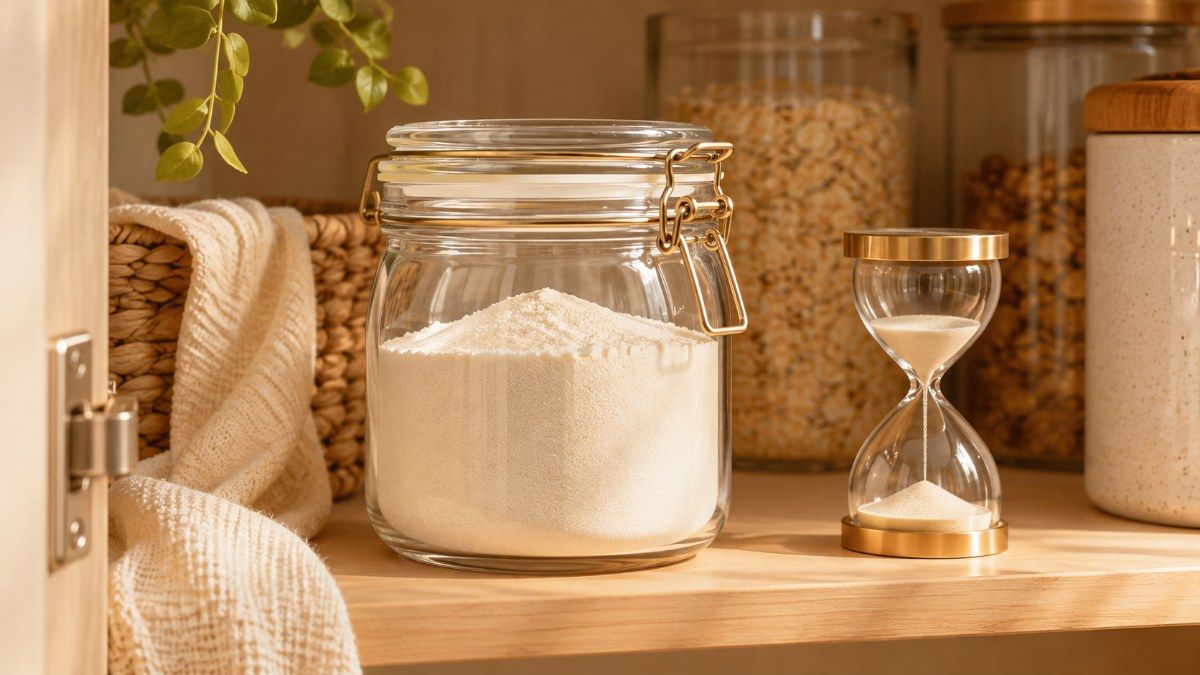
- 1Keep it cool and dry. Normal room temperature is a reasonable target; USP has long defined controlled room temperature as 20 to 25°C (68 to 77°F).
- 2Close the lid or reseal the pouch tightly straight after each use.
- 3Use a completely dry scoop, and never dip a wet spoon or the scoop from your shaker into the tub.
- 4Keep it away from the stove, kettle, coffee machine, dishwasher and sunny windowsills, where heat and steam build up.
Mixing collagen into a hot drink is fine, as explained in collagen in coffee. Once collagen is mixed into a drink, treat it like any other prepared drink and finish it promptly.
Does Collagen Powder Need to Be Refrigerated?
Not unless the label says so. Dry collagen powder does not need a refrigerator, and putting it in one can backfire. Opening a cold container in a warm kitchen lets moisture condense on the powder, which causes clumping; freezing has the same problem. In a hot, humid home, smaller containers are a simpler fix.
Does Liquid Collagen Go Bad After Opening, and What About Gummies and Capsules?
Liquid collagen contains water, so once it is opened it behaves more like a drink than a powder. Follow the storage directions closely, refrigerate it if the label says to, and discard it if it changes smell, colour or texture, or if the container bulges. We found no verified general figure for opened liquid collagen.
Gummies are heat-sensitive: gelatin gummies melt at a much lower temperature than pectin gummies, so a hot car or a sunny shelf can leave them stuck together or misshapen. According to a supplement maker quoted in trade press in August 2026, most gummies carry a two-year shelf life, and formulators often add 20 to 60% extra of some ingredients to cover losses over time.
Capsules are protected from air by their shell and bottle, but humidity can still soften or stick them together. Keep the bottle closed and dry, and discard capsules that are cracked, soft, stuck or discoloured.
When Should You Throw Collagen Out?
- 1It has hard clumps or has set solid.
- 2It smells sour, musty or unusual.
- 3It has turned yellow, tan or brown, or has specks or mold.
- 4The seal, pouch or container is torn, swollen or damaged.
- 5It is past the date on the label and the label does not say otherwise.
- 6Gummies have melted and re-set, or capsules are soft or stuck together.
When to Talk to Your Doctor
- 1If you feel unwell, such as nausea, vomiting or stomach pain, after taking a supplement that may have spoiled
- 2If you have a weakened immune system and are unsure whether an old product is safe to use
- 3If you are pregnant or breastfeeding
- 4If you have kidney disease or follow a protein-restricted diet
- 5If you have a fish, shellfish or other food allergy and are unsure of the collagen source
What to Do Next: A Quick Checklist
- 1Find the date and storage directions on your label and follow them.
- 2Check the powder: colour, smell, texture and whether it dissolves normally.
- 3Inspect the seal and container for damage.
- 4Move the tub to a cool, dry cupboard away from heat and steam.
- 5When buying, choose a size you will finish in a reasonable time and look for third-party testing; see heavy metals in collagen.
- 6Ask your pharmacist or doctor: Is this supplement safe for me past its date? Does my health condition change how I should store or use it? Could it interact with my medicines?
For how much to take and how to fit it into your routine so you finish containers well within date, see how to take collagen peptides.
The Bottom Line
Collagen does expire in the sense that it degrades, but dry, sealed collagen peptides are stable, and ingredient makers report about five years for unopened bulk material. US law does not require supplements to carry an expiration date, though any date that is printed should be backed by data. Moisture, heat and contamination are what spoil collagen, and research on similar protein powders shows clumping, stickiness, browning and new odours once water gets in. Follow the date and storage directions on your label, keep the container cool, dry and closed, and throw out any collagen that is clumped, smelly, discoloured or in damaged packaging.
FAQ
The safest choice is to follow the date on the label. Discard it if it is clumped, smells off, is discoloured or the packaging is damaged.
No independent study sets a time limit after opening; the figures seen online come from sellers. Follow your label's directions and keep the container cool, dry and tightly closed.
No, unless the label says so. Refrigerating dry powder can cause condensation each time you open it, which leads to clumping.
Clumping usually means it has absorbed moisture from humid air, a wet scoop or steam. Discard it if the clumps are hard or it has set solid.
Yes, it can, because it contains water. Store it exactly as the label directs, refrigerate it if instructed, and discard it if the smell, colour or texture changes.
Yes. Most gummies carry about a two-year shelf life, according to a supplement maker quoted in trade press, and gelatin gummies are sensitive to heat. Follow the date on the label.
Sources
- 1US Food and Drug Administration. Small Entity Compliance Guide: Current Good Manufacturing Practice in Manufacturing, Packaging, Labeling, or Holding Operations for Dietary Supplements, FDA (content current as of 2018)
- 2Food and Drug Administration. Current Good Manufacturing Practice in Manufacturing, Packaging, Labeling, or Holding Operations for Dietary Supplements, final rule, 72 FR 34752, Federal Register, 2007
- 3US Food and Drug Administration. Water Activity (aw) in Foods, FDA Inspection Technical Guide
- 4US Food and Drug Administration. Don't Be Tempted to Use Expired Medicines, FDA, 2024
- 5Netto FM, Desobry SA, Labuza TP. Effect of water content on the glass transition, caking and stickiness of protein hydrolysates, International Journal of Food Properties, 1998, doi:10.1080/10942919809524573
- 6Rao Q et al. Accelerated shelf-life testing of quality loss for a commercial hydrolysed hen egg white powder, Food Chemistry, 2012, doi:10.1016/j.foodchem.2012.05.025
- 7Zhao Y et al. Proton dynamics of water diffusion in shrimp hydrolysates flour and effects of moisture absorption on its properties, Foods, 2021
- 8Wu W et al. Physicochemical and flavor characteristics of Maillard reaction products from Nile tilapia fish skin collagen peptides induced by four reducing sugars, Foods, 2025, doi:10.3390/foods14193453
- 9USP Verified Mark frequently asked questions, United States Pharmacopeia
- 10USP proposes to revise the definition of controlled room temperature in chapter 659, ECA Academy GMP News, 2026
- 11NSF develops stability testing guideline for supplements with expiration dates, NutraIngredients, 2011 (trade press)
- 12Beyond the chew: 5 factors that separate quality gummies from failed formulations, SupplySide Supplement Journal, 2026 (trade press)
- 13Rousselot. Peptan B 2000 LD product datasheet, 2019 (manufacturer data); GELITA. PEPTIPLUS product brochure (manufacturer data)
This article summarizes regulations and published research for general information and is not medical advice. Shelf-life figures for bulk ingredients come from the companies that make them, and the spoilage research used other protein powders as stand-ins for collagen.

Dimitrun Irene
Author
Comments (0)
Be the first to comment on this article.
More articles