Collagen and Histamine Intolerance: Is Bone Broth or Collagen a Problem?
No study has measured histamine in collagen or bone broth. What is known about freshness, fermentation, DAO tests and testing your own tolerance safely.
Written by Dimitrun Irene. Updated November 13, 2026.
Nobody knows for sure whether collagen or bone broth is a problem for histamine intolerance, because no published study has measured histamine in collagen peptides, gelatin or bone broth. What we do know is that histamine in food is mostly made by bacteria as food ages, ferments or sits warm, and that cooking does not destroy it once it has formed. That makes freshness and storage time more important than the word "collagen" on a label. A second problem is that histamine intolerance itself is hard to pin down: in a careful placebo-controlled study, most adults who believed they had it did not react to histamine, and German-speaking allergy societies say the common blood test for the enzyme diamine oxidase (DAO) has no diagnostic value. This guide explains what histamine intolerance is, why long-simmered broth might differ from collagen powder, what the evidence does and does not show, and how to test your own tolerance safely with a clinician.
Collagen and Histamine Intolerance: The Short Answer
- 1No study has measured histamine in collagen peptides, gelatin or bone broth, as of November 2026.
- 2Histamine in food comes mainly from bacteria; it builds up with time, warmth and fermentation, and cooking does not remove it.
- 3Collagen peptides are made by enzymes breaking down gelatin, not by fermentation, but raw-material freshness still matters.
- 4Long-simmered or reheated broth may carry more risk than fresh broth, but this is plausible, not measured.
- 5Histamine intolerance is not a validated diagnosis, and the DAO blood test is not recommended for diagnosing it.
- 6A short elimination and reintroduction plan, ideally with a clinician, is the guideline-backed way to test yourself.
What Is Histamine Intolerance, and What Does DAO Have to Do With It?
Histamine is a chemical your body makes and uses for many jobs, including allergic reactions, stomach acid and signals in the brain. It is also found in some foods. A 2020 review in the journal Biomolecules describes histamine intolerance as a disorder linked to an impaired ability to break down histamine that you eat. In the gut, an enzyme called diamine oxidase, or DAO, is the main barrier that breaks down dietary histamine before it reaches the bloodstream. A second enzyme, HNMT, works inside cells. The idea is that when DAO is not doing its job, histamine from food builds up and causes symptoms such as flushing, headache, a runny nose, itching or gut upset.
How common this is remains unclear. Some authors estimate 1% to 3% of the population, but the same review notes a lack of solid data. The review also points out that about 20% of Europeans are estimated to regularly take medicines that can block DAO, including some antibiotics, heart and stomach drugs. Alcohol and other amines in food can compete with histamine for the same enzyme, so the same meal may cause symptoms one day and not another.
Why Is Histamine Intolerance So Hard to Diagnose?
The honest answer is that there is no reliable test. A guideline from the German, Austrian and Swiss allergy societies (led by the German Society for Allergology and Clinical Immunology, version 3.0, revised in 2021) states that measuring DAO activity in the blood has no diagnostic value and that a causal link between histamine intolerance and DAO deficiency is not proven. A next review was planned for July 2026; we did not find an updated version. The Biomolecules review agrees that blood DAO testing cannot be recommended for routine diagnosis until it is validated. One reason is that DAO in the blood may not reflect DAO in the gut, which may explain why studies report deficiency rates from 8% to 80% depending on who was tested.
A 2023 study from the Technical University of Munich tested 59 adults with suspected histamine intolerance using a blinded challenge, where neither patient nor staff knew whether a capsule held histamine or placebo. Of these adults, 62.7% reacted to the placebo, and histamine intolerance was ruled out in 84.7%. Only 15.3% had a plausible or possible diagnosis. A low DAO blood result identified only half of the people with possible histamine intolerance. The guideline also notes that in one study, 75 mg of oral histamine triggered symptoms in about half of healthy volunteers, so reacting to a large dose does not by itself prove a disorder.
Is There Histamine in Collagen Peptides?
We could not find any measurement. No peer-reviewed study we found reports a histamine level for collagen peptides, gelatin or bone broth. Any website giving you a number, or calling collagen "low histamine" or "high histamine", is not citing data.
Here is what we can say. Collagen peptides are made by breaking down collagen or gelatin from animal skin, bones or fish scales with enzymes and heat, a process called enzymatic hydrolysis, as explained in what collagen peptides are. This is not fermentation. Once you swallow them, collagen peptides are digested into free amino acids and small peptides such as Pro-Hyp, much like other proteins. However, histamine cannot be removed by normal cooking or freezing once it has formed, according to the Food Safety Authority of Ireland. So if raw material had spoiled before processing, heat during manufacture would not undo that. Raw-material quality is something you cannot see on the label, which is one reason to choose brands that publish testing.
Why Might Long-Simmered Bone Broth Be Different?
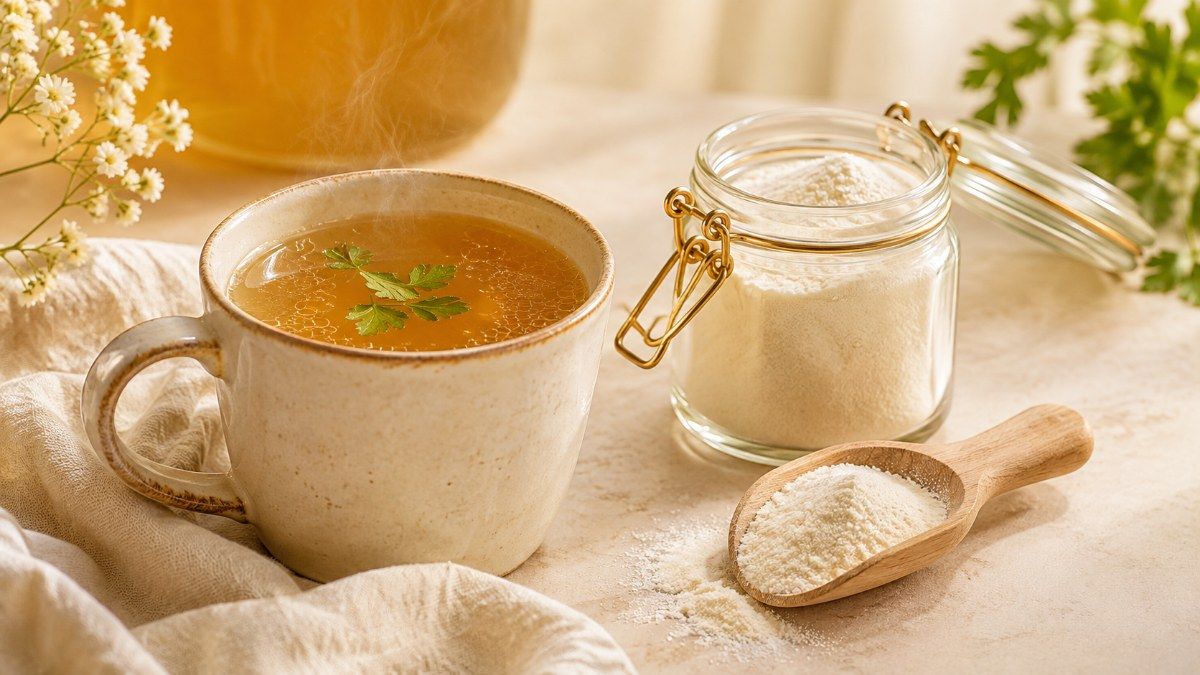
Bone broth is usually simmered for many hours, then cooled, stored and reheated. Histamine forms mainly when bacteria convert the amino acid histidine into histamine, and that happens most in food that has been poorly stored or left warm. The Biomolecules review lists meat and fish that have been altered by microbes, poorly preserved products and fermented foods as the higher-risk groups, while fresh meat and fish are acceptable if freshness is ensured.
Several websites claim that simmering broth for 12 to 48 hours raises histamine, but none cite a measurement, and we found none. It is a reasonable guess that broth left warm for a long time, cooled slowly or kept for days in the fridge could build up more histamine, but nobody has tested it. One cooking study of 27 foods found that boiling lowered histamine in pork, chicken and ham, but the researchers did not measure the cooking water, so we do not know whether histamine moved into the liquid. How broth and powder compare in other ways is covered in bone broth vs collagen peptides.
Bone broth, gelatin and collagen peptides: what is known about histamine
Homemade bone broth
Bones simmered in water
Often many hours, plus cooling and reheating
No (unless fermented ingredients are added)
None found
Slow cooling, long fridge storage, reheating leftovers
Gelatin
Collagen extracted from skin or bone with heat
Factory process
No
None found
Raw-material freshness (not visible to buyers)
Collagen peptides (unflavored)
Gelatin or collagen broken down by enzymes
Factory process
No
None found
Raw-material freshness; added flavors in some products
Broth concentrates and flavored powders
Varies
Varies
Some contain yeast extract or other fermented ingredients
None found
Check labels for yeast extract, vinegar, cheese powder
Does Fermentation Matter, and Are Any Collagen Products Fermented?
Fermentation matters a lot. Low-histamine diets systematically exclude fermented foods, according to the Biomolecules review, because bacteria used in fermentation can produce histamine. Plain collagen peptides are not fermented, but flavored collagen drinks, bone broth powders and broth concentrates can include ingredients such as yeast extract, vinegar, cheese powder or "natural flavors" that may come from fermented sources. If you are trying to reduce histamine, an unflavored product with a single ingredient is easier to judge. For context, EU rules allow 100 to 200 mg of histamine per kilogram in certain fish and up to 400 mg/kg in fish sauce, which shows how much fermented products can carry.
Is Gelatin or Collagen a "Histamine Liberator"?
Many websites and some clinics say gelatin is a "histamine liberator", meaning a food that makes the body release its own histamine. We found no study showing this for gelatin or collagen. More broadly, the German-speaking allergy guideline criticizes advice to avoid histamine liberators as unproven. The guideline also discourages blanket restrictive diets, which can lead to poor nutrition without clear benefit. If you get hives, swelling or wheezing after collagen, that is more likely to be an allergy to the source animal or fish than a histamine problem; see collagen allergy.
What Does the Research Actually Show?
Put simply, the research on histamine intolerance is weak, and the research on collagen and histamine does not exist. Here is how common online claims compare with what the evidence says.
Common claims vs what the evidence says
A low DAO blood test confirms histamine intolerance
Guideline says blood DAO has no diagnostic value; in one study it detected only half (sensitivity 0.5) of possible cases
Most people with symptoms have histamine intolerance
In a blinded challenge of 59 adults, 62.7% reacted to placebo and 84.7% were ruled out
Collagen peptides are low in histamine
No histamine measurements found for collagen peptides
Simmering broth 12 to 24 hours raises histamine
Claimed online without citations; no measurement found
Gelatin is a histamine liberator
No study found; guideline calls the liberator concept unproven
Cooking removes histamine
Histamine is not eliminated by normal cooking or freezing
How Can You Test Your Own Tolerance Safely?
The guideline recommends a three-phase diet rather than lifelong restriction. First, about 10 to 14 days of reducing high-histamine foods. Second, up to about six weeks of reintroducing foods one at a time. Third, a long-term individual diet based on what you actually tolerate. A clinician or dietitian can help you plan this so you do not cut out more than you need to.
- 1Keep a food and symptom diary, including timing, alcohol and any new medicines.
- 2Change one thing at a time, so you can tell what caused a reaction.
- 3Reintroduce collagen in the form you plan to use, such as an unflavored powder in water.
- 4Try fresh broth before stored or reheated broth, and note any difference.
- 5Do not take DAO supplements without advice; the guideline does not recommend them because efficacy is unproven.
If collagen seems to upset your stomach rather than cause flushing or headaches, the cause may be something else; see does collagen cause bloating and the wider list of collagen peptides side effects.
What Else Could Be Causing Your Symptoms?
Because so many people with suspected histamine intolerance react to placebo, it is worth looking for other causes. These include food allergies, mast cell disorders, irritable bowel syndrome, coeliac disease, reflux and side effects of medicines. An allergist can sort through these. Be wary of private IgE allergy panels sold as histamine tests: IgE tests look for allergies, not histamine intolerance. Collagen is sometimes promoted for gut symptoms, but that evidence is limited, as discussed in collagen for gut health.
Is Marine Collagen Lower in Histamine Than Bovine?
We found no data either way. Fish is known to form histamine when it is not kept cold, which is why EU limits exist for certain fish species. But fish collagen is usually made from skin and scales, not the flesh that spoils, and no one has measured histamine in the finished peptides. If you react to fish, a bovine product may be a simpler test. The broader differences are covered in marine vs bovine collagen peptides.
Practical Tips If You Want to Keep Using Broth or Collagen
- 1Make broth in a pot or pressure cooker you can cool quickly; do not leave it lukewarm for hours.
- 2Cool leftovers fast in small, flat containers, as the Swiss patient group SIGHI advises.
- 3Freeze broth in single portions instead of keeping a large pot in the fridge; SIGHI suggests a maximum of 12 to 24 hours in the fridge for leftovers.
- 4Choose unflavored collagen peptides with a short ingredient list.
- 5Avoid broth concentrates with yeast extract or other fermented ingredients during an elimination phase.
When to Talk to Your Doctor
- 1If you have swelling of the lips or throat, wheezing, fainting or widespread hives: seek urgent care.
- 2If symptoms are frequent, severe or getting worse.
- 3Before starting a restrictive diet, especially for children, during pregnancy or if you have a history of eating disorders.
- 4If you take medicines that may affect DAO; do not stop any prescribed drug without advice.
- 5If you have been told you have histamine intolerance based only on a DAO blood test.
Questions to Ask Your Doctor
- 1Could my symptoms be an allergy, a mast cell disorder or a gut condition instead?
- 2Do any of my medicines interact with histamine breakdown?
- 3Can you or a dietitian guide me through a short elimination and reintroduction plan?
- 4Is a blinded food challenge available if my results are unclear?
- 5Is there any reason I should avoid collagen or bone broth specifically?
The Bottom Line
There is no evidence that collagen peptides are high in histamine, and no evidence that they are low; nobody has measured them. Histamine in food tracks freshness, time spent warm and fermentation, so fresh broth cooled quickly and unflavored collagen powder are the lower-risk choices in theory. Histamine intolerance itself is hard to diagnose, and the DAO blood test is not reliable. If you suspect a problem, a short, structured elimination and reintroduction plan with a clinician will tell you more than any online list.
FAQ
No one knows. No published study has measured histamine in collagen peptides. They are not fermented, but raw-material freshness, which buyers cannot see, could matter.
Some people may tolerate fresh broth that is cooled quickly. Long-stored or reheated broth is a more plausible problem, but this has not been measured. Test it during a reintroduction phase.
There are no studies showing this. Hives, swelling or wheezing after collagen are more likely to be an allergy to the source animal or fish.
There is no data comparing them. If you react to fish, a bovine product may be a simpler test.
No. A German-speaking allergy guideline says blood DAO has no diagnostic value, and a blinded study found it missed half of possible cases.
This is a common online claim without supporting studies. The allergy guideline calls the histamine liberator concept unproven.
Sources
- 1Comas-Basté O et al. Histamine Intolerance: The Current State of the Art, Biomolecules, 2020
- 2Reese I et al. (DGAKI, GPA, AeDA, SGAI, ÖGAI). Leitlinie zum Vorgehen bei Verdacht auf Unverträglichkeit gegenüber oral aufgenommenem Histamin (Guideline on management of suspected adverse reactions to ingested histamine), S1 guideline, version 3.0, AWMF 061-030, AWMF guideline register (also published in Allergologie Select), 2021
- 3Bent RK et al. Placebo-controlled histamine challenge disproves suspicion of histamine intolerance, Journal of Allergy and Clinical Immunology: In Practice, 2023
- 4Chung BY et al. Effect of different cooking methods on histamine levels in selected foods, Annals of Dermatology, 2017
- 5Virgilio N et al. Absorption of bioactive peptides following collagen hydrolysate intake: a randomized, double-blind crossover study in healthy individuals, Frontiers in Nutrition, 2024
- 6Food Safety Authority of Ireland. Histamine in fish and fishery products, FSAI
- 7Swiss Interest Group Histamine Intolerance (SIGHI). Therapy: cooking advice, SIGHI, 2018
This article summarizes published research for general information and is not a diagnosis. No study has measured histamine in collagen products; check with a clinician before starting a restrictive diet.

Dimitrun Irene
Author
Comments (0)
Be the first to comment on this article.
More articles