Bone Broth vs Collagen Peptides: Which Gives You More Collagen?
Bone broth's collagen varies batch to batch; peptides give a known dose. Amino acid data, absorption, sodium, lead tests and who might prefer each.
Written by Dimitrun Irene. Updated November 4, 2026.
Bone broth's collagen content varies widely from batch to batch, while a serving of collagen peptides delivers a known, labelled dose. In a 2019 laboratory study by Alcock and colleagues, most bone broths provided significantly fewer collagen building blocks (the amino acids glycine, proline and hydroxyproline) than a 20 gram serving of collagen peptides. Broths bought from cafés scored highest, and one chef-made broth used in a follow-up trial turned out to be far richer than the researchers expected. That does not make broth the better source; it shows how much broth can vary. Collagen peptides are collagen broken into small pieces so the powder dissolves easily. This guide compares amino acids, absorption, sodium, lead testing and cost.
Bone Broth vs Collagen: The Short Answer
- 1Consistency: broth varies a lot between batches and brands; peptides give a fixed dose per scoop.
- 2Amount: tested broths contained 2.5 to 8 g of collagen per cup, against the 15 to 20 g used in many studies of peptides.
- 3Absorption: in one small trial, broth raised blood amino acids more slowly than peptides, but total exposure was similar.
- 4Sodium: USDA entries range from 343 to 893 mg of sodium per cup of stock or broth.
- 5Lead: an early letter reported trace lead in broth; later tests rated the risk minimal.
- 6Benefits: neither has strong proof for skin or joint benefits; broth has almost no human trials.
What's the Difference Between Bone Broth and Collagen Peptides?
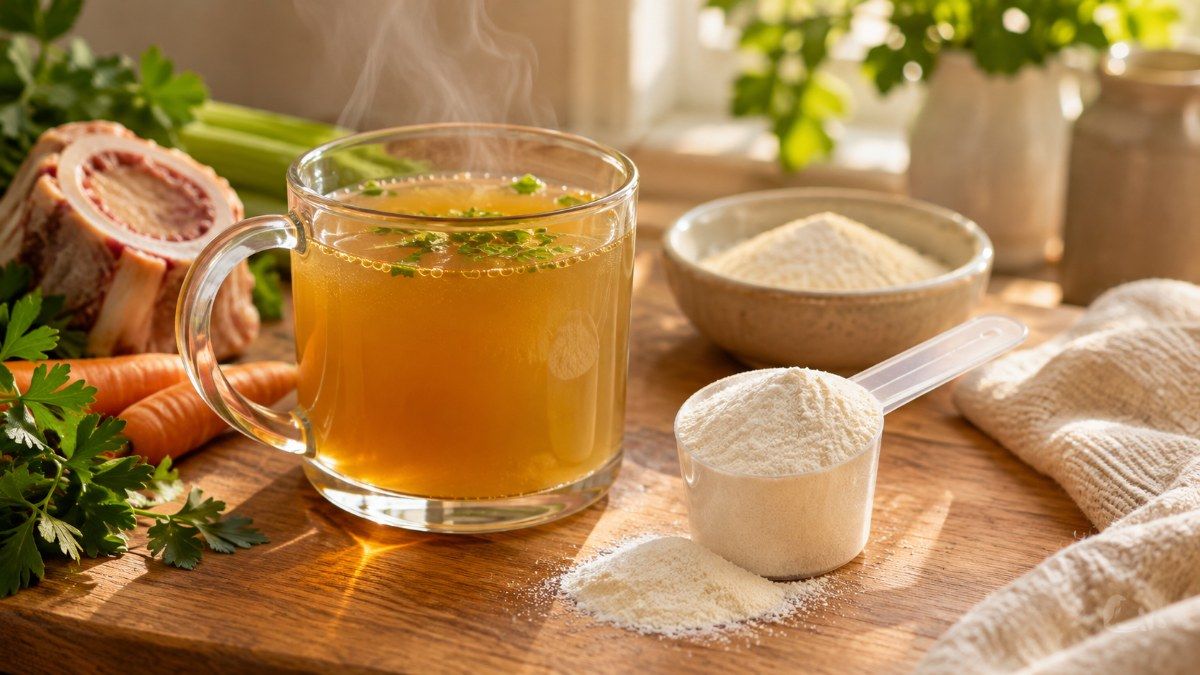
Bone broth is made by simmering animal bones, skin and connective tissue in water for many hours. Some of the collagen in those tissues breaks down into gelatin and dissolves into the liquid, along with fat, salt and whatever else is in the pot. How much ends up in your cup depends on the bones, cooking time and amount of water.
Collagen peptides start from the same kinds of animal tissue, but the collagen is extracted and then cut into short chains by enzymes, a process called hydrolysis. The result is a powder that is almost entirely protein, sold with a stated number of grams per scoop. Gelatin is collagen partly broken down by heat, which is why it sets. For a fuller explanation of the terms, see collagen vs collagen peptides and what are collagen peptides.
Is Bone Broth a Good Source of Collagen?
It can be, but you cannot know how good a particular cup is without testing it. In the 2019 study by Alcock, Shaw and Burke, published in the International Journal of Sport Nutrition and Exercise Metabolism, researchers measured amino acids in home-made, café and commercial broths and compared them with a 20 gram reference dose of collagen. Broths made to a standard recipe were significantly lower than the reference dose for hydroxyproline, glycine and proline, and also for hydroxylysine, leucine and lysine. Café broths were the richest and shop-bought commercial broths were lower than home-made ones.
The authors concluded that bone broth is "unlikely" to be a "consistently reliable source" of the amino acids found in collagen. Batches made to the same recipe were consistent with each other, so the recipe matters most.
How Much Collagen Is in a Cup of Bone Broth?
Independent figures are scarce. In 2018 the testing company ConsumerLab analysed 10 bone broth products and reported 2.5 to 8 grams of collagen per cup, 3.8 to 13.3 grams of protein and 95 to 503 mg of sodium. One product contained 62% less protein than its label claimed.
By comparison, the collagen peptide studies discussed below used 15 to 20 grams in a single serving. On the ConsumerLab figures, that is roughly two to eight cups of broth.
Bone broth vs collagen peptides per serving
Protein
2.74 to 6.05 g in USDA entries; 3.8 to 13.3 g in ConsumerLab tests
About 20 g of amino acids (20,594 mg measured)
Collagen
2.5 to 8 g in ConsumerLab tests
20 g
Glycine
Not listed by USDA; 11,760 mg in one unusually rich 300 mL chef-made broth
4,904 mg
Sodium
USDA entries range from 343 to 893 mg (15% to 39% of the daily value)
Low in unflavoured powders; check the label
Consistency
Varies by recipe, brand and batch; one product had 62% less protein than labelled
Fixed dose stated on the label
Bone Broth vs Collagen Peptides: How Do the Amino Acids Compare?
A second 2019 Alcock study, in Frontiers in Nutrition, gave 15 men gelatin, collagen peptides or chef-made broth and measured amino acids in each serving and in their blood.
Amino acids per serving and blood glycine peak (Alcock et al. 2019, Frontiers in Nutrition)
Gelatin, 20 g
20,108
4,750
2,664
588
674
71
Collagen peptides, 20 g
20,594
4,904
2,722
584
747
48
Chef-made broth, 300 mL
52,260
11,760
6,420
1,710
666
88
At first glance the broth looks far better, with more than twice the amino acids of the peptide serving. But the authors noted that this broth batch was "considerably higher than expected", and they only found this out after the trial had finished. Read alongside their earlier study, in which most broths fell well short of 20 grams of collagen, the result is best understood as evidence that broth is variable, not that it is reliably richer.
Is Collagen From Bone Broth Absorbed as Well as Peptides?
In the same trial, peptides produced the fastest rise in blood glycine: a peak of 747 µmol/L at about 48 minutes, against 674 µmol/L at 71 minutes for gelatin and 666 µmol/L at 88 minutes for broth. Proline from broth peaked significantly later, at about 103 minutes. However, the total amount of amino acids reaching the blood over the test period did not differ significantly between the three.
Iwai and colleagues showed in 2005 that small collagen fragments, mainly prolyl-hydroxyproline (Pro-Hyp), reach the blood 30 to 120 minutes after eating hydrolysed gelatin. No study has shown that broth delivers these fragments better than peptides do.
How Much Protein and Sodium Does Bone Broth Have?
USDA FoodData Central lists protein and sodium for several stocks and broths but gives no collagen or amino-acid values. Home-prepared chicken stock contains 6.05 g of protein and 343 mg of sodium per cup, home-prepared beef stock 4.73 g of protein and 475 mg of sodium, and canned ready-to-serve beef broth 2.74 g of protein and 893 mg of sodium. The daily value for sodium is 2,300 mg, and the US Food and Drug Administration describes 20% of the daily value or more per serving as high.
Collagen peptides supply much more protein per serving, but collagen is not a well-balanced protein for meeting daily needs on its own, as explained in collagen peptides vs protein powder.
Should You Worry About Lead in Bone Broth?
The concern began with a small 2013 letter by Monro and colleagues in Medical Hypotheses, a journal for untested ideas. As summarised by a lead-safety group, the letter reported lead at 9.5 µg/L in broth made from skin and cartilage and 7.01 µg/L in broth made from bones, against 0.89 µg/L in the tap water used. By our calculation that is roughly 1.7 to 2.3 µg per cup. Its methods are not clear from the sources we could check.
Later and larger tests were reassuring. Hsu and colleagues in 2017 tested 19 commercial broth servings from Taiwan and found mean lead of 2.63 to 4.27 µg/L, or 1.5 to 2.1 µg per serving, and called the risk "minimal". Calcium and magnesium each supplied under 5% of daily needs. Košečková and colleagues in 2024 tested 30 broths and found lead mostly below detection limits, with a maximum of 12 µg/L, and cadmium up to 2.4 µg/L; they also judged the risk minimal. In short, trace lead has been found, but there is no evidence of harm from typical intake. Contaminant testing of supplements is covered in heavy metals in collagen.
Which Costs Less Per Gram of Collagen?
There is no reliable answer as of November 2026, because we found no sourced, current prices. The ConsumerLab review in 2018 found that the cost of getting an equivalent amount of collagen from bone broth products ranged from $0.61 to $9.99, a sixteen-fold spread. If cost matters, compare collagen products by dividing the price by the total grams of collagen in the pack; how to choose collagen peptides explains what else to check on the label.
Bone Broth vs Collagen: What Do the Claims and the Evidence Say?
Common claims about bone broth and collagen peptides vs the evidence
Bone broth is packed with collagen
Tested products held 2.5 to 8 g per cup; most broths in Alcock 2019 were significantly lower than 20 g of collagen
Broth collagen is absorbed better than supplements
Peptides raised blood glycine faster (48 vs 88 min); total exposure did not differ
Bone broth is rich in calcium and magnesium
Each supplied under 5% of daily needs per serving in Hsu 2017
Bone broth is contaminated with lead
Trace lead found; Hsu 2017 and Košečková 2024 rated the risk minimal
Collagen peptides are proven to improve skin
A 2025 meta-analysis of 23 trials found no benefit in independent or higher-quality trials; industry disputes this
Collagen with vitamin C boosts collagen building
In 8 men, gelatin plus vitamin C raised a collagen marker 153% vs 54% with placebo; the marker may not reflect tendons
What Does the Research Say About the Benefits of Each?
Broth claims rest on its collagen content rather than trials of broth itself. For collagen peptides, the evidence is mixed. A 2025 meta-analysis by Myung and Park in the American Journal of Medicine pooled 23 randomised trials with 1,474 participants and found no skin benefit in trials without industry funding or in higher-quality trials; the supplement industry has disputed that conclusion. Skin research is reviewed in collagen peptides for skin, hair and nails.
For connective tissue, a small 2017 study by Shaw and colleagues gave 8 men 15 grams of gelatin with 48 mg of vitamin C before exercise. A blood marker of collagen production called PINP rose by 153% at four hours, against 54% with placebo, though this marker may not reflect what happens in tendons. More on that research is in collagen for tendons and ligaments and collagen and vitamin C.
Who Might Prefer Bone Broth, and Who Might Prefer Peptides?
- 1Bone broth may suit people who want a savoury, warm food that adds fluid and some protein, or who like cooking with leftover bones.
- 2Collagen peptides may suit people who want a known dose (studies used 15 to 20 g), low sodium and no cooking.
- 3Anyone limiting sodium should read broth labels; some canned broths supply close to 40% of the daily value per cup.
- 4People who want both can have broth as food and use peptides when they want a measured amount; see how to take collagen peptides.
When to Talk to Your Doctor
- 1If you have high blood pressure, heart failure or kidney disease and need to limit sodium or protein
- 2If you are pregnant, breastfeeding or feeding broth to young children and are concerned about lead
- 3If you have a fish, shellfish or other food allergy, since collagen can come from several animal sources
- 4If you are using broth or collagen to manage joint, tendon or skin problems
What to Do Next: Questions to Ask Your Doctor
- 1How much sodium a day is right for me, and does a daily cup of broth fit within it?
- 2Do I need extra protein, and is collagen a sensible way to get it?
- 3Is there any reason for me to avoid collagen supplements or broth?
- 4If I try collagen for a specific goal, how should I judge whether it is working?
People on GLP-1 weight-loss drugs often ask whether collagen or bone broth can cover their protein needs; see collagen and GLP-1 medications.
The Bottom Line
Bone broth can contain collagen, but how much varies so widely between recipes, brands and batches that you cannot rely on it for a set dose; most broths tested in 2019 fell well short of a 20 gram collagen serving, and the one unusually rich batch shows variability rather than superiority. Collagen peptides deliver a known amount with little sodium. Enjoy broth as a food; choose peptides if you want to match research doses. Neither has strong evidence for skin or joint benefits.
FAQ
Not if you want a reliable dose. Tested broths contained 2.5 to 8 g of collagen per cup, and amounts vary between batches, while peptide servings in studies were 15 to 20 g.
In Alcock 2019, commercial broths were lower than home-made ones, and café broths were the highest. Results still depend heavily on the recipe.
Gelling shows that gelatin is present, but we found no study linking how firmly broth sets to a measured amount of collagen, so it is only a rough sign.
Yes. Some people stir unflavoured collagen peptides into broth or soup. Keep an eye on the total sodium from the broth.
For most people, yes. Studies rated the lead risk minimal, but sodium can be high, so people limiting salt should check labels.
It can be. USDA entries range from 343 mg per cup for home-prepared chicken stock to 893 mg for canned beef broth, or 15% to 39% of the daily value.
Sources
- 1Alcock RD, Shaw GC, Burke LM. Bone broth unlikely to provide reliable concentrations of collagen precursors compared with supplemental sources of collagen used in collagen research, International Journal of Sport Nutrition and Exercise Metabolism, 2019
- 2Alcock RD et al. Plasma amino acid concentrations after the ingestion of dairy and collagen proteins, in healthy active males, Frontiers in Nutrition, 2019
- 3Hsu DJ et al. Essential and toxic metals in animal bone broths, Food and Nutrition Research, 2017
- 4Košečková P, Zvěřina O, Letková K. Nutritional insights into broths in relation to elemental composition, European Food Research and Technology, 2024
- 5Iwai K et al. Identification of food-derived collagen peptides in human blood after oral ingestion of gelatin hydrolysates, Journal of Agricultural and Food Chemistry, 2005
- 6Shaw G et al. Vitamin C-enriched gelatin supplementation before intermittent activity augments collagen synthesis, American Journal of Clinical Nutrition, 2017
- 7Myung SK, Park Y. Effects of collagen supplements on skin aging: a systematic review and meta-analysis of randomized controlled trials (doi:10.1016/j.amjmed.2025.04.034), American Journal of Medicine, 2025
- 8USDA FoodData Central: chicken stock, home-prepared (172884), via getfoodfacts.com, USDA SR Legacy
- 9USDA FoodData Central: beef stock, home-prepared (172883), via getfoodfacts.com, USDA SR Legacy
- 10USDA FoodData Central: beef broth, canned, ready-to-serve (171538), via getfoodfacts.com, USDA SR Legacy
- 11Sodium in your diet, US Food and Drug Administration
- 12ConsumerLab tests bone broth products, Nutraceuticals World, 2018
This article summarizes published research for general information and is not medical advice. Some collagen studies, including several in the 2025 meta-analysis, were funded by collagen manufacturers.

Dimitrun Irene
Author
Comments (0)
Be the first to comment on this article.
More articles